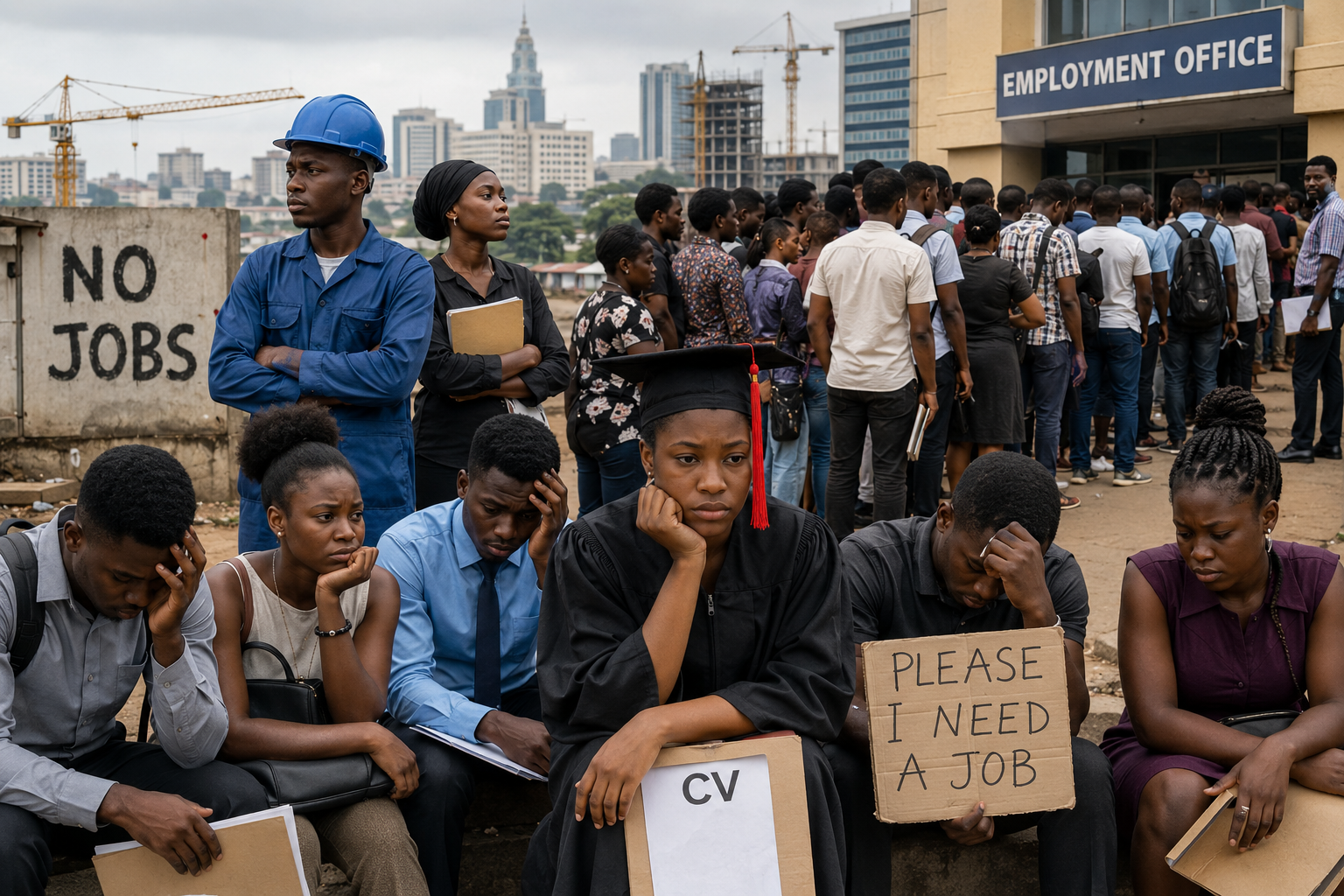
…Nearly Two Million Youth Left Unemployed
By Kwabena Adu Koranteng
Nearly two million young Ghanaians are trapped in a cycle of unemployment, inactivity and hopelessness, according to the latest figures from the Ghana Statistical Service (GSS), exposing what analysts describe as one of the greatest threats to the country’s economic future and social stability.
The stark reality is that 19.5 per cent of Ghanaians aged between 15 and 35 years—roughly one in every five young people are neither in education, employment nor training (NEET). Behind the statistics are millions of shattered ambitions, wasted talent and growing frustration among a generation increasingly questioning whether the promise of a better future still exists.
The figures, released to commemorate World Population Day, paint a disturbing picture of a country struggling to create opportunities for its youthful population despite years of political promises, employment initiatives and skills programmes.
For thousands of graduates, school leavers and skilled artisans, the search for employment has become a full-time occupation with little reward.
Many spend years moving from one job interview to another, sending countless applications without success, while others have abandoned the formal labour market altogether. Increasing numbers are surviving through irregular informal work that offers little income, no job security and no prospects for career advancement.
The GSS data reveal that approximately two million young people have effectively been left outside the country’s education and productive employment systems—a situation economists warn could undermine Ghana’s long-term development.
The Numbers Tell a Grim Story
The challenge extends beyond those classified as NEET.
According to the Quarterly Labour Force Survey, youth unemployment averaged 21.9 per cent during the first three quarters of 2025—almost double the national unemployment rate of 12.8 per cent.
The statistics suggest that even those actively searching for work face enormous barriers to entering the labour market.
Compounding the crisis is Ghana’s changing population structure. Young people now account for 36.9 per cent of the country’s estimated population of 33.7 million, compared with 34.6 per cent in 2000.
Rather than becoming the engine of economic transformation, a significant portion of this growing population risks becoming economically marginalised.
The Hidden Cost of Early Pregnancy
The GSS also drew attention to another challenge silently reducing the country’s productive capacity—adolescent pregnancy.
Data from the 2022 Ghana Demographic and Health Survey indicate that 15 per cent of girls aged between 15 and 19 have experienced pregnancy, while 11 per cent have already given birth.
For many young girls, pregnancy marks the end of formal education and the beginning of lifelong economic disadvantage.
Without access to education, vocational training or stable employment, many struggle to escape poverty, creating an intergenerational cycle that places additional pressure on families and public services.
A Nation Paying the Price
The consequences of widespread youth inactivity extend far beyond unemployment statistics.
Economic experts have repeatedly warned that prolonged joblessness among young people weakens productivity, reduces tax revenues, increases dependence on social support systems and discourages private investment.
It also heightens the risks of crime, substance abuse, political violence, irregular migration and other social challenges that thrive where opportunities are scarce.
With nearly two million young people disconnected from education and productive work, Ghana risks carrying an increasingly heavy economic burden instead of benefiting from the innovation, energy and creativity that young people can offer.
A Narrow Window of Opportunity
The Ghana Statistical Service is urging decisive action before the challenge deepens further.
It has called for expanded investment in technical and vocational education, stronger school-to-work transition programmes, support for entrepreneurship and accelerated growth in industries capable of creating decent, sustainable jobs.
The warning is unmistakable.
Whether Ghana transforms its youthful population into a powerful driver of economic growth or allows it to become a source of deepening unemployment, frustration and instability will depend on decisions taken today.
The country still possesses one of its greatest assets: a young, energetic and ambitious population.
But unless meaningful investments are made in education, skills development and job creation, that asset could become one of Ghana’s most pressing national challenges.
The clock is ticking, and for nearly two million young Ghanaians waiting on the sidelines, time is rapidly running out.