By Kwabena Adu Koranteng
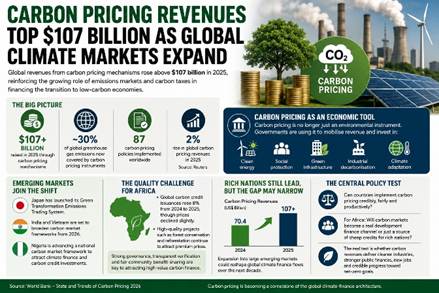
Global revenues generated from carbon pricing mechanisms surpassed US$107 billion in 2025, underscoring the growing importance of emissions markets and carbon taxes in financing the transition to low-carbon economies.
According to the latest report by the World Bank, carbon pricing is steadily evolving from a purely environmental policy instrument into a major fiscal and industrial policy tool, reshaping how governments mobilise climate finance and steer economic transformation.
In its 2026 State and Trends of Carbon Pricing Report, the World Bank disclosed that carbon pricing instruments now cover nearly 30 per cent of global greenhouse gas emissions, with 87 carbon-pricing policies currently implemented worldwide.
The report revealed that governments raised more than US$107 billion in public revenues in 2025 through emissions trading systems, carbon taxes and related frameworks that compel companies and industries to pay for their greenhouse gas emissions.
The rise in revenues reflects growing international momentum behind carbon markets. Global news agency Reuters reported that worldwide carbon pricing revenues increased by 2 per cent in 2025, even as carbon prices varied significantly across different jurisdictions.
Carbon Pricing Becomes Economic Policy
What is increasingly evident is that carbon pricing is no longer viewed solely as a climate mitigation tool.
Governments are now treating emissions pricing as a strategic mechanism for generating public revenue, financing infrastructure, accelerating industrial decarbonisation and supporting broader economic development.
The World Bank noted that revenues generated from carbon pricing can be channelled into critical sectors such as renewable energy, green infrastructure, climate adaptation, social protection programmes and industrial transformation.
This shift is particularly significant for emerging economies grappling with rising debt burdens and fiscal constraints.
The report highlighted that all major middle-income economies have either implemented or are planning direct carbon pricing instruments, signalling an important shift in global climate governance.
Emerging Economies Move Into Carbon Markets
Across Asia and Africa, momentum is building.
Japan recently launched its Green Transformation Emissions Trading System, designed to mobilise financing for energy transition and industrial decarbonisation. Meanwhile, countries such as India and Vietnam are preparing to expand carbon market frameworks beginning in 2026.
In Africa, Nigeria is actively positioning itself to benefit from the emerging carbon economy through national carbon market reforms aimed at attracting climate-linked investments and carbon credit financing.
For many African countries, the opportunities are substantial.
The continent possesses enormous potential in forest conservation, renewable energy projects, methane reduction, clean cooking technologies, sustainable agriculture and nature-based carbon solutions.
However, experts warn that Africa’s success in attracting meaningful carbon finance will depend heavily on the credibility of regulatory systems, transparent monitoring frameworks and stronger investor confidence in the quality of carbon credits issued.
The Quality Challenge Facing Africa
The World Bank reported that global carbon credit issuances increased by 8 per cent between 2024 and 2025, although prices declined modestly during the period.
Not all carbon credits, however, command equal market value.
Higher-quality projects—particularly those linked to international aviation compliance systems, forest conservation and reforestation programmes continue to attract premium pricing.
For African countries, this distinction could prove decisive.
Markets characterised by weak governance structures, poor verification systems or unresolved land and community-benefit disputes may struggle to attract premium carbon investments.
By contrast, countries able to establish credible governance and transparent benefit-sharing systems could position themselves as preferred destinations for corporate climate finance.
Rich Nations Still Dominate
Advanced economies continue to account for the majority of carbon pricing revenues due to their longer-established trading systems and higher carbon prices.
Yet analysts believe the growing participation of large emerging markets could significantly reshape global climate-finance flows over the coming decade.
For governments facing shrinking fiscal space, carbon pricing presents an increasingly attractive revenue source.
But the political risks remain significant.
Poorly designed carbon taxes or emissions schemes could increase energy and production costs for households and businesses, particularly in energy-intensive industries, unless revenues are recycled effectively through subsidies, tax incentives, targeted compensation or green investment programmes.
Africa’s Critical Question
The central challenge is no longer whether countries can introduce carbon pricing mechanisms.
Rather, the question is whether they can implement them credibly, equitably and productively.
For Africa, the issue is even more pressing: Will carbon markets become a meaningful development-finance channel, or will the continent remain largely a supplier of cheap carbon credits to wealthier nations?
The World Bank’s latest findings suggest carbon pricing is becoming an increasingly influential pillar of the global climate-finance architecture.
The true test for emerging economies, however, will lie in whether rising carbon revenues translate into cleaner industries, stronger public finances, job creation and credible progress toward net-zero ambitions.