By the time the first women began gathering at the Accra Metropolitan Assembly Park, it was clear that Tuesday’s demonstration would be more than an ordinary political procession.
They came from markets, offices, businesses, homes and political organisations. Some carried placards. Others came with their voices, their stories and a simple but powerful message: “Enough is Enough.”
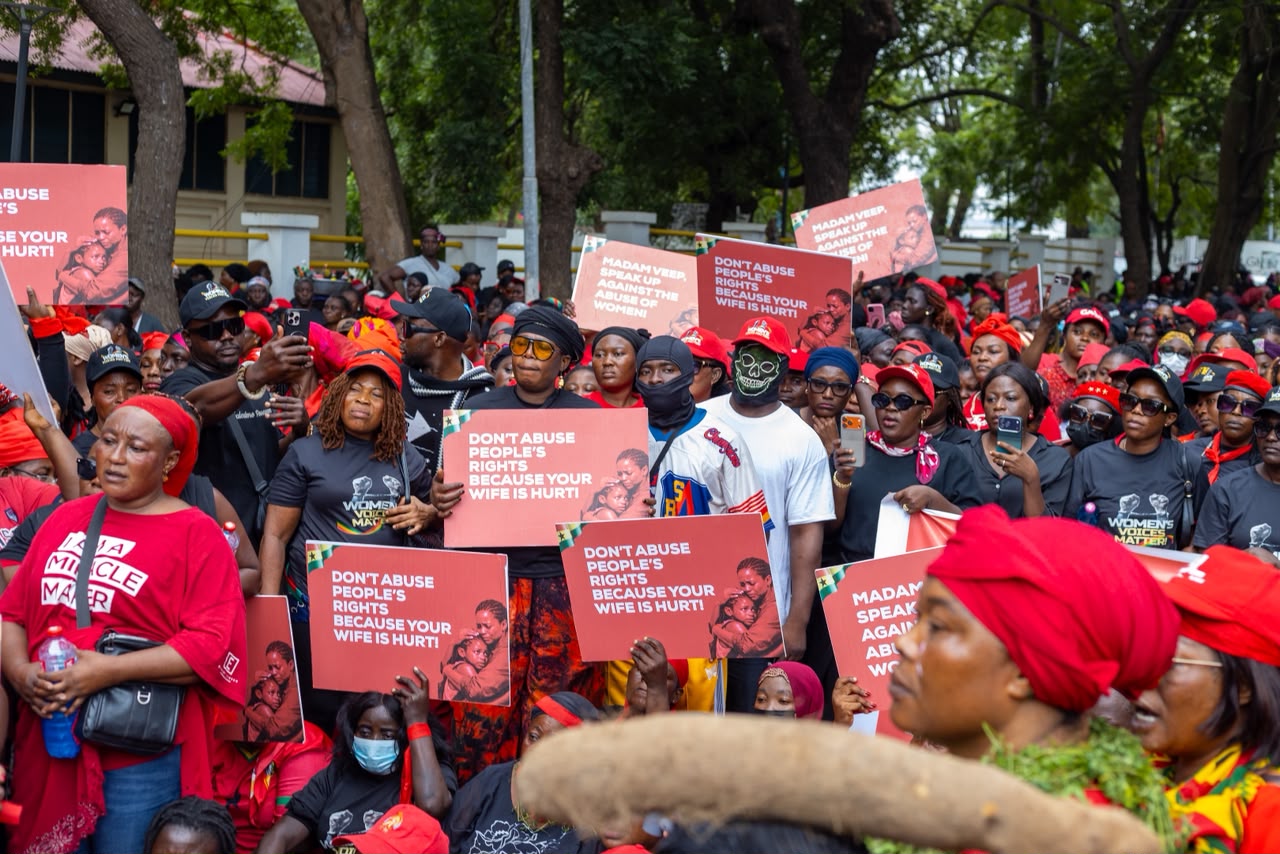
Among them was former New Patriotic Party parliamentary aspirant for Adenta, Akosua Asaa Manu, who joined thousands of women in a rare show of cross-party solidarity under the banner “Women’s Voices Matter.”
For hours, the streets of Accra became a moving theatre of women’s demands for justice, equality, dignity, freedom of expression and protection of their constitutional rights.
The march brought together women who ordinarily may stand on opposite sides of Ghana’s political divide. On this occasion, however, party colours appeared secondary to a shared concern over what the organisers described as injustice, abuse and the need to safeguard the rights and dignity of Ghanaian women.
From the AMA Park, the procession moved through the principal streets of the capital towards the Ministry of Gender, Children and Social Protection.
The chants grew louder.
“Enough is Enough!”
The placards told their own stories.
And behind the slogans was a deeper demand: that women should be able to speak, disagree, criticise and participate in public life without fear of arbitrary treatment, while also receiving equal protection under the law.
The demonstration was convened by PNP Chairperson Janet Asana Nabla, NDP Chairperson and Leader Betty Akuffo Amoabeng, LGP Running Mate Elizabeth Sam, Akosua Asaa Manu, Advisor on Gender and Social Protection to the NPP Flagbearer, and NPP Gender and Social Protection Committee Spokesperson Grace Akosua Amoabeng.
What made the march particularly striking was its breadth. Market women walked alongside political activists. Hairdressers marched beside professionals. Dressmakers, kayayei, businesswomen and women from different political traditions joined the procession.
It was, in many ways, a portrait of Ghanaian womanhood on the streets of Accra.
The protesters’ concerns have emerged against the backdrop of several recent arrests involving women and other citizens over alleged offensive statements, social-media activity, threats and false-news allegations.
Among the cases drawing attention is that of Salomey Awity Baffoe, a 40-year-old mother of three, whose arrest in connection with investigations into the “Ghana Jollof” social-media account has generated public discussion.
The protesters insisted, however, that their concerns went beyond any individual case.
Their message was about the principle. They argued that the state has a legitimate responsibility to enforce the law, but that enforcement must be accompanied by respect for due process, human dignity and constitutional freedoms.
At the Ministry of Gender, Children and Social Protection, the women presented a petition to Minister Dr Agnes Naa Momo Lartey, formally placing their concerns before government.
The petition marked the culmination of a march that had transformed the streets of Accra into a powerful platform for women’s voices.
Tuesday’s demonstration therefore represented more than a gathering of political supporters.
It was a moment in which women from different backgrounds stood together and declared that their voices mattered and that justice, dignity, equality and constitutional protection could not be treated as privileges.