For thousands of commuters who use the Adenta–Dodowa and Dodowa–Somanya roads daily, every journey has become a dangerous gamble with life, a punishing experience many residents say no citizen should endure in a country that prides itself on development.
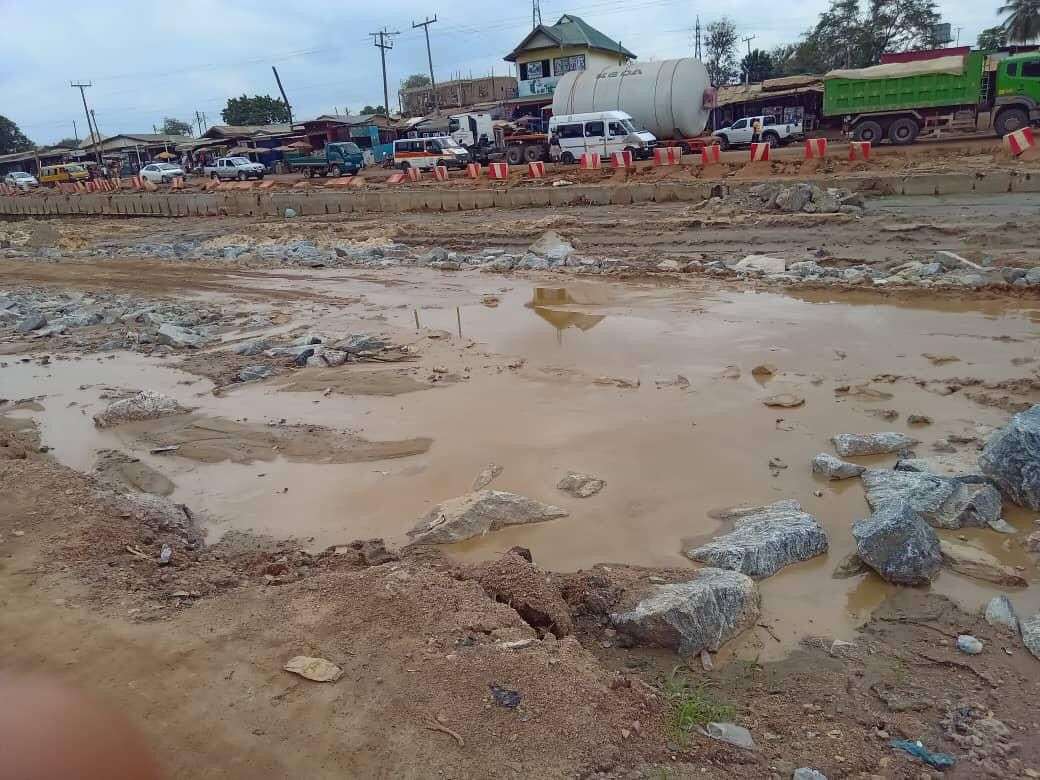
What were once expected to be critical economic and transportation corridors have now deteriorated into what angry residents describe as “roads of suffering”—highways riddled with deep potholes, exposed manholes, broken surfaces and worsening drainage systems that have turned travel into a nightmare.
The Adenta–Dodowa stretch, in particular, has become a symbol of frustration and neglect. Drivers liken the experience to navigating rocky mountains rather than travelling on a major road connecting communities to the capital city.
“Even in the first century, horses may have travelled on better roads,” one frustrated commuter remarked.
Across long stretches of the highway, motorists are forced to dangerously zigzag through crater-sized potholes, exposing passengers to frightening moments and increasing the risk of collisions.
Commercial drivers say what should be straightforward driving has become an exhausting exercise in survival.
“You can’t even drive normally anymore,” a commercial driver said angrily. “Every minute you are changing direction to avoid potholes or exposed manholes. If you are not careful, you destroy your car or crash.”
Residents claim the deteriorating condition of the roads is contributing to rising accidents, damaged vehicles and avoidable deaths.
Some also fear the harsh, violent movement experienced on the roads is taking a toll on vulnerable passengers, particularly pregnant women, the elderly and people with medical conditions. Health experts generally advise caution on rough roads during pregnancy, though individual medical outcomes vary.
Adding to the misery, residents say poor drainage along sections of the roads has worsened flooding during heavy rains, with water invading homes and destroying household property.
For many businesses, the bad roads are steadily strangling economic activity. Traders transporting goods complain of delays and losses, while vehicle owners say maintenance costs are spiralling due to constant damage to tyres, suspension systems and shock absorbers.
Yet beyond the physical suffering lies a deeper grievance—one rooted in politics.
Several residents accuse government of deliberately neglecting the roads because the affected areas are perceived to be politically loyal strongholds where votes are considered guaranteed regardless of development.
According to them, authorities appear to have slowed or ignored road rehabilitation efforts under the assumption that residents will continue voting the same way whether the roads are fixed or abandoned.
“We feel punished,” one resident lamented. “It is like government believes we will vote anyway, so our suffering does not matter.”
Though such claims remain politically contentious, the perception of neglect is fuelling growing anger among residents who insist infrastructure development must never be determined by electoral calculations.
For commuters, traders, workers and schoolchildren who depend on the roads daily, the suffering is becoming unbearable.
Residents are now demanding immediate action, warning that every delay in reconstruction means more damaged vehicles, more accidents, more economic hardship—and potentially more lives lost.
The growing question echoing across these communities is both painful and urgent: Must peop le continue to suffer and die before these roads finally receive attention?