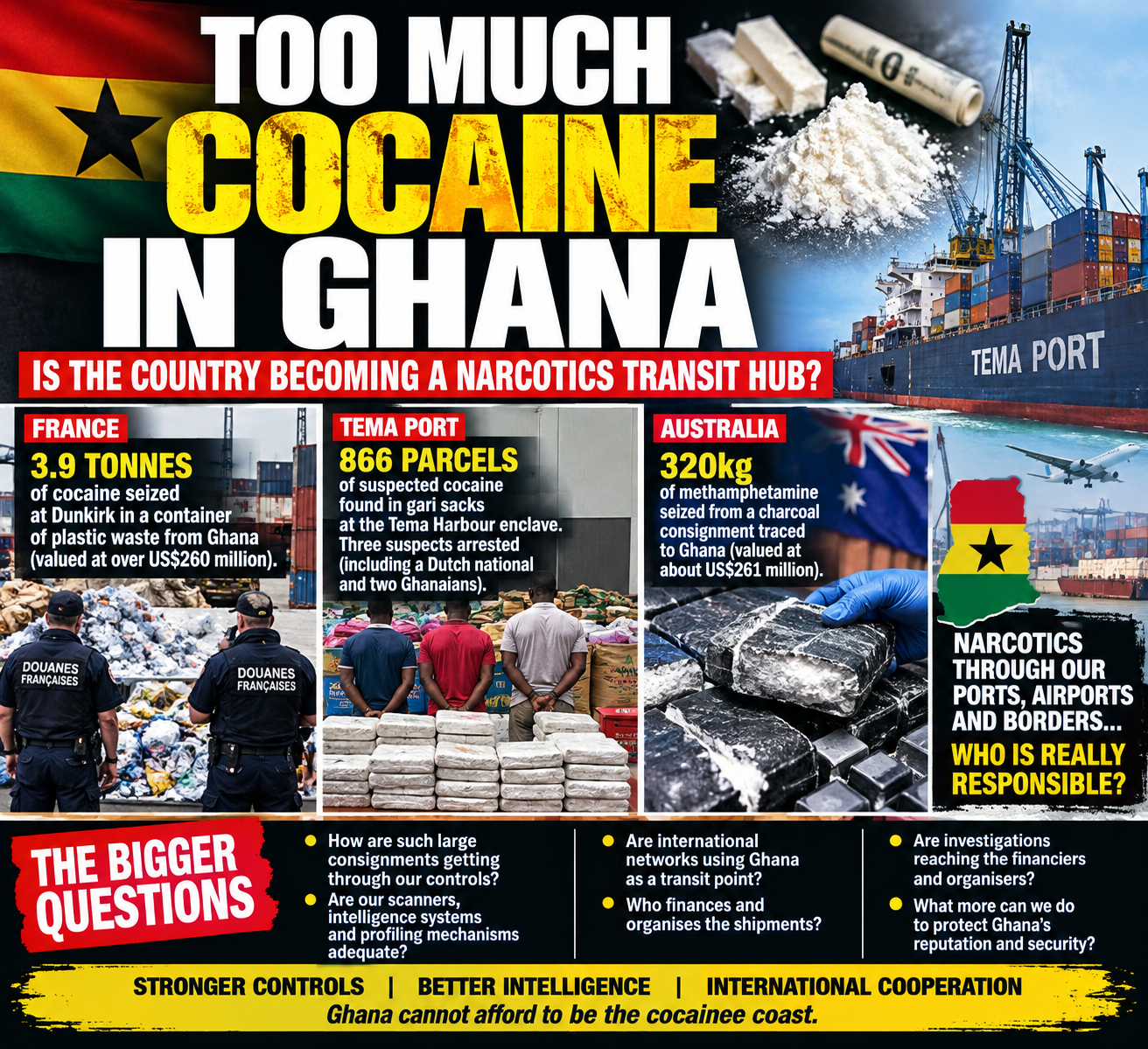
Ghana is facing renewed scrutiny over a series of major narcotics seizures linked to the country, with recent interceptions in Ghana, France and Australia raising questions about the effectiveness of controls at the country’s ports, airports and borders.
The most striking case came in September 2026, when French customs authorities seized nearly 3.9 tonnes of cocaine, valued at more than US$260 million, from a container of plastic waste that had departed Ghana and was intercepted at Dunkirk.
The case followed the August 5, 2026 seizure of 866 parcels of suspected cocaine concealed in sacks of gari at a warehouse within the Tema Harbour enclave. Three suspects, including a Dutch national and two Ghanaians, were arrested.
There are also reports of 320kg of methamphetamine valued at about US$261 million seized by Australian authorities in June 2026 from a charcoal consignment traced to Ghana.
Ghana’s Minority in Parliament has subsequently called for a parliamentary investigation, arguing that the frequency and scale of seizures linked to Ghana warrant scrutiny of the country’s anti-narcotics and port-security systems. The Minority has put the value of several seizures it cites at more than US$1 billion over less than two years—a political claim that should be distinguished from independently verified totals.
Meanwhile, Ghana’s Narcotics Control Commission says it operates drug-enforcement units at Kotoka International Airport, seaports, borders and courier facilities, including surveillance, screening, profiling and cargo examinations.
How are such large consignments getting through Ghana’s export and port controls?
Are Ghana’s scanners, intelligence systems and cargo-profiling mechanisms adequate?
Are international trafficking networks exploiting Ghana as a transit point?
Who finances and organises the shipments?
Are investigations reaching the financiers and organisers, rather than only couriers and facilitators?
What information are European and other international law-enforcement agencies sharing with Ghana?
What reforms are required at Tema Port, Kotoka Airport and Ghana’s borders?
The scale of the recent cases makes the issue bigger than individual seizures. It is now a question of border security, international cooperation, institutional controls and Ghana’s reputation as a trading and transit country.