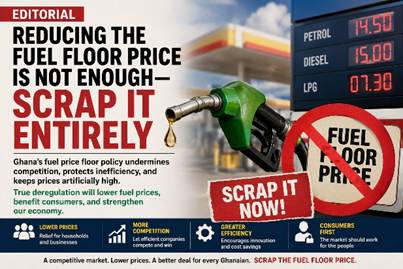
The decision by the National Petroleum Authority (NPA) to reduce the floor price of petroleum products deserves recognition. At the very least, it signals a regulator that appears willing to listen to concerns from industry players, consumers, and policymakers over the growing dissatisfaction surrounding fuel pricing in Ghana.
But while the reduction may offer temporary relief, it fails to confront the deeper structural flaw at the heart of Ghana’s downstream petroleum sector.
The uncomfortable truth is this: reducing the fuel floor price is merely adjusting the temperature of a broken system. The real solution lies in abolishing the policy altogether.
A deregulated petroleum market cannot coexist comfortably with state-imposed pricing restrictions. It is economically contradictory and intellectually inconsistent to preach deregulation while simultaneously imposing a minimum price below which companies are forbidden to sell fuel.
What exactly, then, is deregulated about a market where businesses cannot freely determine prices based on operational efficiency, procurement advantage, and market realities?
The answer is simple—very little.
The essence of deregulation is competition. Companies compete to become more efficient, secure cheaper supplies, improve service delivery, and ultimately attract customers through lower prices. Consumers become the biggest beneficiaries because market rivalry forces prices downward.
Yet Ghana’s fuel price floor undermines this principle.
By preventing Oil Marketing Companies (OMCs) from selling below a prescribed minimum, the NPA effectively neutralises the most important competitive weapon in a petroleum retail market—pricing.
Petrol and diesel are largely standardised commodities. One litre of fuel at one filling station is fundamentally no different from another. In such a market, price naturally becomes the dominant basis for competition.
When regulators artificially restrain price competition, they unintentionally reward inefficiency while punishing innovation.
Efficient companies that negotiate better supply deals or reduce operational costs should be free to transfer those savings to consumers. Instead, they are constrained by regulation, compelled to maintain artificially elevated prices.
Who benefits from such an arrangement?
Certainly not the ordinary Ghanaian commuter struggling with transport fares. Certainly not businesses battling rising operational costs. Certainly not traders whose prices rise because fuel costs remain stubbornly high. In reality, the policy risks protecting industry complacency at the expense of consumers.
The NPA may argue that the floor price was introduced to prevent “unhealthy competition” and ensure market stability. That concern is understandable. No responsible regulator wants destructive pricing wars that threaten industry sustainability.
But stability should never become an excuse for suppressing competition. Markets function best when efficiency—not regulation—determines winners and losers. Moreover, Ghana’s economic realities demand a consumer-first approach. Fuel prices influence nearly every sector of the economy. Transport fares, food inflation, industrial production, and household expenditure are all directly affected.
At a time when Ghanaians continue to battle high living costs, policymakers must ask themselves a fundamental question: Should regulation protect market players from competition—or should it protect consumers from unnecessarily high prices?
The answer should be obvious. If some OMCs can genuinely sell fuel cheaper due to better supply arrangements or operational efficiencies, then consumers deserve access to those lower prices.Global oil market volatility, driven by geopolitical tensions and shifting supply routes, means some firms will inevitably access cheaper products than others. A rigid price floor blocks consumers from enjoying those benefits.
That is neither economically sound nor socially fair. The NPA deserves credit for taking a step forward by reducing the floor price. But half-measures rarely solve systemic problems.
Ghana must decide whether it truly believes in deregulation or merely prefers the appearance of it. If deregulation is to mean anything at all, then market competition—not administrative controls—must determine fuel prices. Reducing the floor price is commendable. Scrapping it entirely is the real reform Ghana needs.