The use of ethnic rhetoric disguised as intellectual discourse remains a deeply concerning trend in many postcolonial societies. At a time when numerous African nations continue to grapple with political instability, economic inequality, and the unfinished project of national integration, public intellectuals must exercise caution and responsibility when addressing sensitive issues related to ethnicity, nationalism, and political identity. Scholarly debate should encourage critical reflection and historical awareness rather than amplify division, resentment, or ethno-political tensions. As Franz Fanon warned, postcolonial societies remain vulnerable to elite-driven forms of political fragmentation when leaders prioritize ideological theatrics over nation-building.
Professor Kwamena Ahwoi’s interpretation of colonialism as an exclusively European phenomenon, presented during the workshop organized by the Inter-Ministerial Coordinating Committee on Decentralization on May 19, 2026, reflects a deeply reductionist and historically indefensible reading of colonialism as a global political process. Such a narrow interpretation disregards centuries of documented territorial expansion, conquest, cultural domination, and political subjugation carried out by non-European powers throughout history. By confining colonialism solely to the European experience, Professor Ahwoi advances a selective historical narrative that distorts the broader realities of imperial expansion and weakens serious scholarly engagement with the complexities of state power, conquest, and domination.
While European imperialism undoubtedly reshaped Africa in profound and devastating ways, the broader historical concept of colonial expansion has also included conquest, territorial domination, cultural assimilation, and political subjugation carried out by regional powers throughout world history. Historical scholarship has repeatedly demonstrated that domination and expansion are not uniquely European practices but recurring features of state formation and imperial politics. Consequently, public discussions of political history require nuance, contextualization, and scholarly precision rather than selective historical framing.
The Asante Kingdom, as reflected in its name “esa enti,” functioned as a colonial power whose political expansion mirrored many of the fundamental characteristics historically associated with imperial domination. Like European colonial powers, the Asante Kingdom engaged in military conquest to expand its territorial authority while imposing its political structures, cultural practices, and traditions upon conquered kingdoms and ethnic groups. To deny these historical realities, while simultaneously restricting the definition of colonialism exclusively to European—particularly British—imperialism, represents a selective and historically unsustainable interpretation of colonial domination. Such a position not only oversimplifies the broader history of empire-building but also obscures the realities of regional conquest, cultural subordination, and political expansion carried out by non-European powers throughout history. To associate colonialism solely with Europe—particularly Britain—is a serious distortion of history.
Equally concerning is Professor Ahwoi’s repeated use of speculative language such as “could” and “most likely” when discussing secession, ethnic fragmentation, or national instability. Responsible scholarship requires evidence-based argumentation. Assertions about national disintegration must be grounded in historical analysis, political data, and careful comparative methodology rather than rhetorical projection. In deeply pluralistic societies, speculative political statements can unintentionally legitimize extremist interpretations or reinforce existing social tensions.
Suggesting that the Asante Kingdom might secede if a “troublesome” king is enthroned reflects a deeply irresponsible rhetorical framing that risks legitimizing divisive political interpretations. What does Professor Ahwoi mean by “troublesome,” and what traits define such a chief? Professor Ahwoi often interprets a troubling pattern of political contradiction and selective interpretation in his opponents’ policies, particularly regarding the division of the nation’s regions under the National Patriotic Party government. While critical of others’ regional divisions, he was silent about similar actions when he served as Minister for Local Government and Decentralization, which reveals a striking inconsistency between Professor Ahwoi’s past political conduct and his present criticisms. Although I do not support any government’s decisions on regional divisions, I prefer to engage with facts rather than personal opinions, which are less designed to advance scholarly understanding than to delegitimize the government through rhetorical provocation, as Professor Ahwoi appears to do.
Professor Ahwoi’s suggestion that Ghana could eventually disintegrate in a manner similar to Yugoslavia or the Soviet Union requires greater analytical care and empirical grounding. Comparisons between states with distinct political histories, economic systems, and constitutional arrangements can become misleading when detached from historical specificity. The collapse of the Soviet Union, for example, emerged from a combination of economic stagnation, authoritarian governance, geopolitical pressure, and institutional crisis rather than from ethnic diversity alone. Simplistic analogies risk inflaming anxieties rather than contributing to informed national dialogue. To enhance Professor Ahwoi’s understanding of the dissolution of the Soviet Union, I recommend that he read the works of Ambassador Jack F. Matlock. Notable titles include “Reagan and Gorbachev: How the Cold War Ended,” “Superpower Illusions: How Myths and False Ideologies Led America Astray—And How to Return to Reality,” and “Autopsy on an Empire: The American Ambassador’s Account of the Collapse of the Soviet Union.” It is also important to note that Ukraine was never the “intellectual center” of the Soviet Union. Additionally, the Soviet Union did not collapse in the late 1990s; it actually disintegrated in 1991.
My criticism of Professor Ahwoi’s comments should not be interpreted as hostility toward any ethnic group, region, or political community. The purpose of this critique is not to promote ethnic antagonism, chauvinism, or division. Rather, it is to defend the principle of national cohesion and to emphasize the ethical responsibility of intellectuals in postcolonial societies. As Mahmood Mamdani argues, societies emerging from colonial histories must resist political narratives that transform cultural identities into permanent political divisions. Public debate should strengthen democratic citizenship and collective responsibility rather than encourage suspicion between communities.
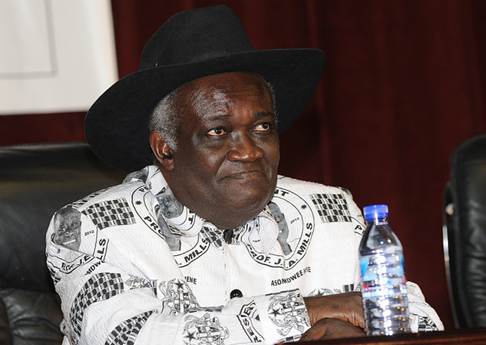
Since 1979, I have observed a nation that was once celebrated for producing some of the finest scholars and leaders in postcolonial Africa, and throughout the newly liberated Global South, undergo profound institutional, intellectual, and moral deterioration. Intellectuals who once stood as scholars have now abandoned the responsibilities of serious scholarship in favour of inflammatory populist commentary. The Marxists of the past, including Professor Ahwoi, who actively encouraged the nation to endure the hardships of economic austerity in the early 1980s and 1990s, have adopted a taste for Western fashion and cowboy culture. Today, many of these former intellectuals are at the forefront of creating a culture of clientelism and opportunism, reinforcing political patronage systems that discourage intellectual independence, critical inquiry, and democratic accountability.
The broader issue at stake is the role of intellectuals within fragile democratic systems. Throughout the postcolonial era, many African nations produced scholars and political thinkers whose contributions emphasized liberation, Pan-Africanism, and national development. However, there is growing concern that segments of the Ghanaian intellectual class increasingly prioritize media visibility, political spectacle, and ideological provocation over constructive scholarship and civic responsibility. Intellectual authority should contribute to thoughtful public engagement rather than inflammatory rhetoric.
At the same time, national governments and political elites must also acknowledge legitimate frustrations related to inequality, resource distribution, regional marginalization, and governance failures. Citizens across diverse ethnic communities often express shared concerns regarding corruption, economic hardship, unemployment, and political exclusion. Addressing these structural concerns requires institutional reform, transparency, and inclusive governance rather than divisive rhetoric. The long history of intermarriage, cultural exchange, and social hybridity within Ghana demonstrates that there remains far more that unites the population than divides it.
It is therefore important to reaffirm that discussions surrounding ethnicity, nationalism, and historical memory must be approached with humility, introspection, and scholarly responsibility. While vigorous intellectual debate is essential within democratic societies, careless public statements about secession, ethnic superiority, or national fragmentation can have serious social consequences. Words carry political weight, especially when delivered by prominent public figures. Responsible leadership requires balancing academic freedom with civic accountability.
Ultimately, this critique represents a defence of national unity, historical accuracy, and responsible public scholarship rather than an attack on any ethnic identity or cultural tradition. Constructive criticism within a democracy should encourage deeper reflection and more rigorous scholarship, not hatred or division. Nations are strengthened when intellectuals engage with complexity, historical evidence, and ethical responsibility while resisting the temptation to inflame ethnic tensions for political or rhetorical effect.
Osagyefo Dr. Kwame Nkrumah’s words should serve as a serious warning and enduring point of reflection for political leaders and public intellectuals, particularly when engaging in rhetoric that carries profound national security and social implications. At a time when political discourse can easily inflame ethnic tensions and deepen societal divisions, leaders must recognize that careless public statements are not harmless academic exercises but interventions with potentially destabilizing consequences.
In one of his timeless speeches, Osagyefo Dr. Kwame Nkrumah declared, “As far as I am concerned, I am aware that death can never extinguish the torch I have lit in Ghana and Africa. Long after I am dead and gone, the light will continue to burn and be upheld, providing light and guidance to all people.” This statement reflects a vision of leadership grounded not in political provocation or intellectual spectacle, but in national unity, historical responsibility, and collective advancement. Professor Ahwoi and his contemporaries would benefit from reflecting more carefully on the nation-building significance of such words rather than contributing to forms of public discourse that risk deepening political fragmentation and ideological division.