
Adu Koranteng Reports
The rising unemployment rate in Ghana has reached alarming levels and is increasingly posing a serious threat to the country’s national security. The government’s inability to create sufficient jobs for the growing number of young people, particularly graduates, has created widespread frustration and social instability.
Many unemployed youths, left with limited options for survival, have resorted to criminal activities such as cybercrime, armed robbery, theft, car snatching, and kidnapping. These activities have contributed to rising insecurity across the country. As a result, several young people have been arrested, with many currently serving prison sentences or being held on remand for crimes linked to unemployment-induced desperation.
Graduates Share Their Struggles
Philip Asante, a graduate of the University of Ghana, completed his studies three years ago with a Second Class Upper in Political Science. After completing his National Service, he has been unable to secure employment.
“As I speak to you, I am currently pursuing a Master’s degree in Business Administration, but I still do not have a job. I have become a burden on my parents, who feed me daily and still pay my school fees. I feel sad and frustrated,” he said.
“Our national leaders have ignored us. During the 2024 political campaign, politicians promised jobs and a 24-hour economy, but after the elections, those promises have vanished. The policy is not even reflected in the national budget. We need help and support.”
Sophia Asamoah, a 28-year-old graduate of the University for Development Studies, completed her education six years ago but remains unemployed.
“I am considering travelling abroad to seek greener pastures because there are no opportunities here. I have applied to about 15 institutions without success. I am tired and ready to try my luck elsewhere,” she stated.
Ibrahim Awudu Abubakre, 30, a graduate of the University of Cape Coast, also shared his ordeal.
“I currently work as an Uber driver, but the car does not belong to me. I work part-time when the owner is not using it. I also do construction work as a labourer to earn extra income. Life is hard without a decent job. I pray I get one soon,” he added.
Alarming Statistics
The Government Statistician, Dr. Alhassan Iddrisu, has confirmed that Ghana’s unemployment rate remains high, with youth unemployment exceeding 25%.
According to the Ghana Statistical Service (GSS) Quarterly Labour Statistics Bulletin released in December 2025, Ghana’s unemployment rate rose to 13.0 per cent in the third quarter of 2025, up from 12.8 per cent previously.
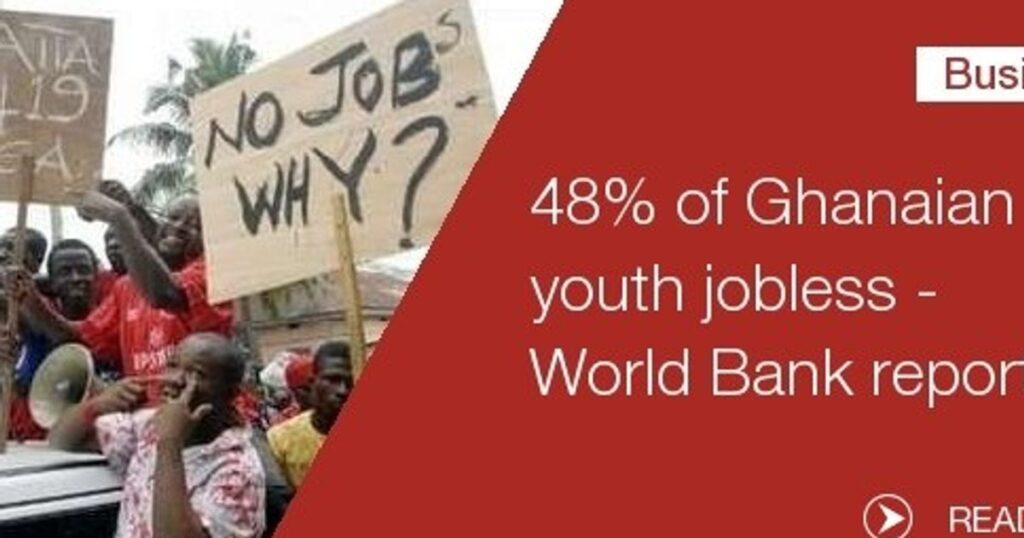
Youth unemployment continues to surpass the national average. Unemployment among persons aged 15–24 years averaged 32.5 per cent, while those aged 15–35 years recorded 21.9 per cent in the second and third quarters of the year.
Dr. Iddrisu further revealed that over 70 per cent of Ghana’s labour force, mostly women and young people, operates within the informal sector.
“This is not just a jobs gap; it is a dignity gap,” he emphasized.
The report also highlighted gender and location disparities. Female unemployment remained higher than male unemployment by an average gap of 3.7 percentage points, while urban unemployment averaged 15.1 per cent, compared to 9.6 per cent in rural areas.
Additionally, the number of young people classified as Not in Education, Employment, or Training (NEET) continues to rise. In the third quarter, approximately 1.34 million people aged 15–24 years (21.5 per cent) and 1.95 million people aged 15–35 years (19.5 per cent) fell into this category.
Job Quality and Work Patterns
Beyond unemployment, the bulletin examined job quality. About 53.8 per cent of employed persons reported full utilisation of their skills, while 20.9 per cent said their skills were only partially utilised, particularly among females and rural workers.
Interest in non-traditional work arrangements is also growing. In the third quarter, 46.5 per cent of workers not engaged in shift work expressed interest in such arrangements, while 39.5 per cent were not interested and 14 per cent would consider it depending on conditions.
The rising unemployment rate, particularly among the youth, is not only an economic concern but a pressing national security issue. Without urgent and sustainable job creation policies, Ghana risks further social unrest, increased crime, and the loss of its young, skilled population to migration.