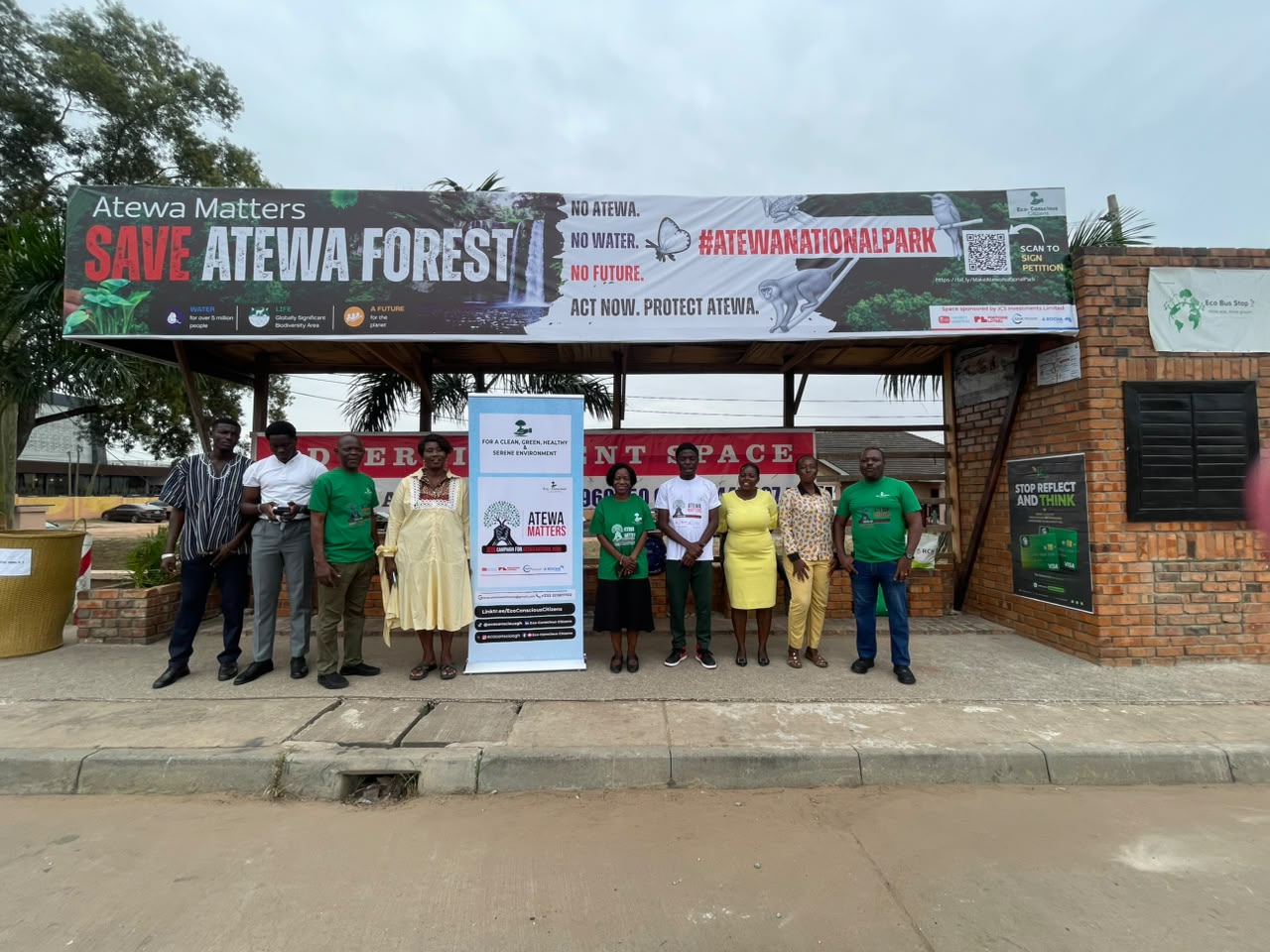
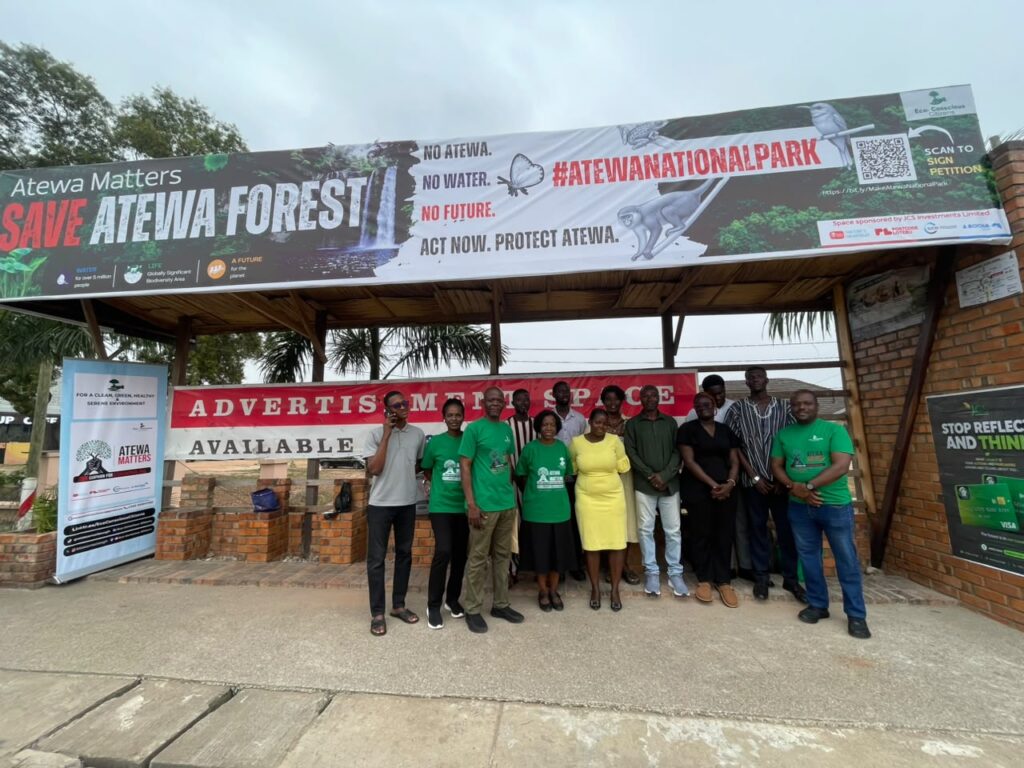
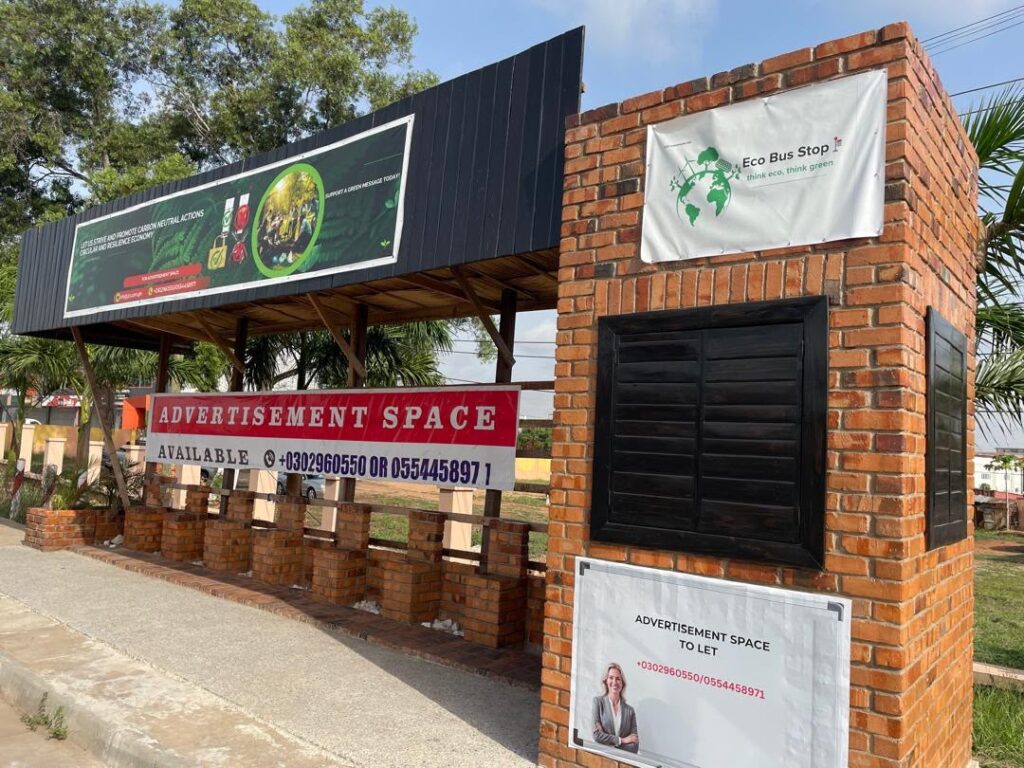
A new collaboration between EcoConscious Citizens and JCS Investments Limited is seeking to place environmental protection at the centre of everyday public life, using an innovative eco-friendly bus stop as a platform for environmental education and advocacy.
The initiative brings together private-sector investment and civil-society environmental activism, with both organisations calling for greater public awareness and stronger action to protect Ghana’s forests, water bodies and natural resources.
Patricia Safo, Chief Executive Officer of JCS Investments Limited, said the company initiated the construction of the eco-centric bus stop after observing conventional bus stops being developed across municipalities without sufficient emphasis on environmental issues.
According to her, JCS approached the relevant municipal authorities with the proposal, secured the necessary permission and subsequently developed the facility as a platform for promoting environmental awareness.
“We wanted to make a difference,” Ms Safo explained, stressing that the facility was designed not simply as a transportation point but as a public space where environmental issues could be communicated to citizens.
She said the initiative reflects JCS Investments’ broader commitment to impact investment, noting that the company has been involved in the area for more than two decades.
‘EVERY ACTION TELLS A STORY’
Ms Safo argued that environmental protection must become part of everyday decision-making, particularly consumer choices.
She said individuals and businesses must constantly assess whether their activities are adding value to the planet or contributing to environmental degradation.
According to her, history will ultimately judge the present generation by the environmental legacy it leaves behind.
She therefore called on citizens to pause and reflect on their daily actions and consider whether those actions contribute positively to environmental conservation and the wellbeing of future generations.
A major area of concern for JCS is plastic pollution.
Ms Safo noted that more than 90 countries have introduced bans on certain single-use plastics and argued that the economic and environmental costs associated with plastic pollution make a strong case for decisive action.
She maintained that environmental responsibility and economic development should not be treated as opposing objectives.
THE GREEN CARD INITIATIVE
As part of its effort to encourage environmentally responsible consumption, JCS Investments is developing initiatives intended to give consumers greater power to influence the market through their purchasing decisions.
Ms Safo highlighted the company’s Green Card, developed in collaboration with UBA, as one such initiative.
She explained that the concept is based on the belief that consumer purchasing decisions can influence the products businesses produce and sell.
The Green Card, she said, is intended to encourage consumers to make more environmentally conscious choices by distinguishing between green and non-green products.
“We believe there’s power in purchasing because it is economics that drives everything,” she said.
The initiative seeks to transform environmental consciousness from an abstract concept into something consumers can practise through their everyday spending.
ATEWA MATTERS CAMPAIGN
The partnership also supports the environmental advocacy work of EcoConscious Citizens, particularly its Atewa Matters campaign.
Awula Serwah, Executive Director of EcoConscious Citizens, said the campaign is focused on securing stronger protection for the Atewa Forest Reserve, including its proposed designation as a National Park.
She explained that Atewa has remained an important forest ecosystem for generations but is increasingly threatened by illegal mining, poaching and other human activities.
According to Ms Serwah, three major rivers originate from the Atewa Forest and the forest contributes to the water supply of millions of Ghanaians.
She stressed that protecting Atewa is therefore not merely about preserving trees and wildlife but also about protecting water security and human livelihoods.
The forest, she added, provides a habitat for endangered species and diverse flora and fauna.
Using a simple analogy, Ms Serwah compared the forest to a person’s home.
Destroying the forest, she argued, effectively makes the species that depend on it homeless.
JCS SUPPORTS ATEWA CAMPAIGN
Ms Serwah expressed appreciation to JCS Investments for supporting the campaign by providing space on its eco-friendly bus stop for the Atewa Matters campaign banner.
She said the facility includes containers for plastic waste and is expected to incorporate additional greenery and flowers as the project develops.
She also acknowledged the contribution of A Rocha Ghana to the creation of the campaign banner.
According to her, the collaboration is based on a shared commitment to environmental protection.
“The environment matters,” she stressed, urging Ghanaians to take environmental issues more seriously.
She further encouraged the public to learn more about JCS Investments’ environmentally focused initiatives and its TopUp Card, which she said forms part of the company’s broader green agenda.
GALAMSEY: ‘WE CAN STOP IT’
But beyond the partnership and environmental education campaign, Ms Serwah used the occasion to issue a strong challenge to government over the continuing destruction caused by illegal mining, popularly known as galamsey.
She argued that Ghana has the capacity to stop illegal mining but lacks the political will to take the decisive measures required.
According to her, successive governments have announced campaigns and enforcement operations, but these have often resulted in isolated arrests and the destruction of some mining equipment without dismantling the wider networks behind illegal mining.
She called for a more comprehensive national response involving the full resources of the state.
Ms Serwah said government should consider declaring a state of emergency over illegal mining and deploy the security agencies to protect the country’s water bodies and forest reserves.
‘WATER IS LIFE’
For Ms Serwah, the environmental consequences of illegal mining extend far beyond the destruction of landscapes.
She warned that the contamination of Ghana’s rivers and other water bodies poses a direct threat to public health, agriculture and the country’s future water security.
She expressed concern about the use of toxic substances such as mercury, cyanide and arsenic in illegal mining and cautioned that contaminated water may not always show visible signs of pollution.
“When you are drinking water and it’s colorless, it doesn’t mean there’s no cyanide in it. It doesn’t mean there’s no mercury,” she warned.
Her message was simple: clear water is not necessarily clean water.
She urged Ghanaians to recognise the seriousness of water pollution and demand stronger action from the authorities.
A NATIONAL ENVIRONMENTAL EMERGENCY?
Ms Serwah believes Ghana must begin treating illegal mining as a national emergency rather than as a series of isolated law-enforcement incidents.
She argued that periodic operations in which a few miners are arrested or excavators destroyed do not address the deeper structures supporting illegal mining.
Instead, she wants a coordinated operation involving the Army, Navy and other relevant security agencies to reclaim polluted water bodies and protect vulnerable forest reserves.
Her call represents a significant escalation in the environmental debate.
For her, the issue is not simply about illegal miners operating in isolated communities. It is about the country’s water, food security, forests, biodiversity and the health of future generations.
She warned that the consequences of inaction could become irreversible.
PRIVATE SECTOR MEETS ENVIRONMENTAL ACTIVISM
The collaboration between JCS Investments and EcoConscious Citizens demonstrates how private-sector initiatives can intersect with civil-society environmental advocacy.
The eco-bus stop is modest in physical scale, but its intended purpose is much broader.
It creates a visible public platform for environmental messaging while demonstrating how infrastructure can incorporate sustainability into everyday urban life.
For JCS Investments, the project is part of a philosophy that environmental responsibility must become embedded in ordinary economic activity.
For EcoConscious Citizens, it provides another avenue to reach the public with a message about forests, water and responsible citizenship.
Together, the partners are attempting to turn an ordinary bus stop into an environmental classroom.
THE NEXT GENERATION IS WATCHING
The broader message emerging from the initiative is that environmental protection cannot be left solely to government agencies or environmental organisations.
Businesses, consumers, communities and individuals all have roles to play.
From the products people purchase to the plastics they dispose of, and from the protection of forests to the fight against illegal mining, everyday decisions collectively shape Ghana’s environmental future.
Patricia Safo’s call for citizens to examine whether their actions are adding value or degrading the planet echoes Awula Serwah’s warning about the consequences of environmental destruction.
One speaks from the perspective of impact investment and responsible consumption.
The other speaks from the frontline of environmental advocacy.
But their message converges on one fundamental principle:
Ghana cannot sacrifice the environment in the pursuit of short-term economic gains and expect future generations to pay the price without consequence.
The eco-bus stop may therefore represent more than a piece of urban infrastructure.
It is a statement.
A statement that environmental consciousness belongs in public spaces, in businesses, in consumer choices—and ultimately, in the national conversation about Ghana’s future.
And as the Atewa Matters campaign continues to push for stronger protection of Ghana’s forests, the warning from environmental advocates is becoming increasingly difficult to ignore:
Protect the environment today, or leave tomorrow’s generation to inherit the consequences.