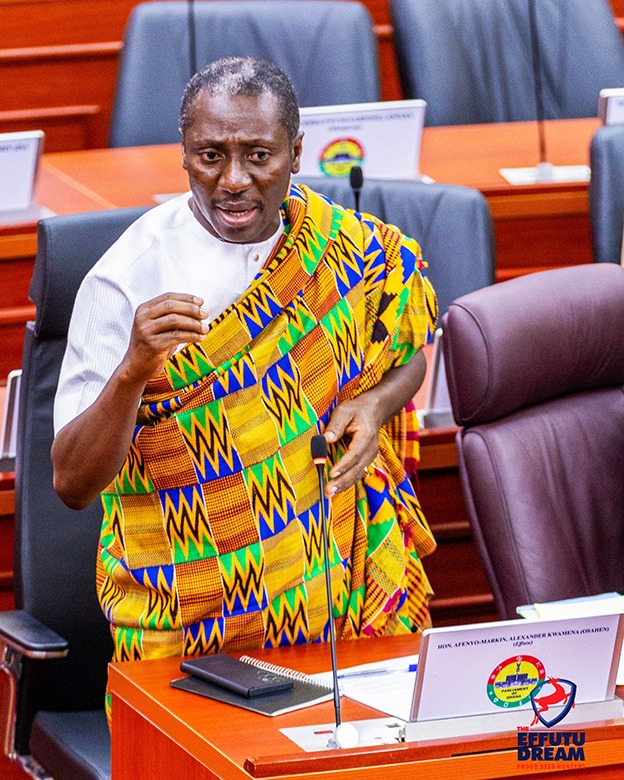
A whitepaper examining Ghana’s parliamentary opposition as a model for democratic resilience across Africa has been published in international journals. The study, titled “Institutionalizing a Strong and Responsible Opposition for Democratic Resilience in Africa: A Ghana Case Study (2025/2026 Review)”, places Hon. Alexander Afenyo‑Markin, Ghana’s Minority Leader, and the country’s opposition structure at the heart of a continent‑wide conversation on preventing coups and deepening democracy.
The paper is now available as a preprint on ResearchGate, Academia.edu, Zenodo, and SSRN, and has been submitted to peer‑reviewed journals for formal publication.
The African Chamber of Content Producers (ACCP) and the Universal Peace Federation (UPF) Ghana, together with partner institutions such as the African Progressive Research and Innovations, have a core mandate: to project and protect a positive image of Africa. In recent years, the dominant narrative about the continent has been one of coups, declining press freedom, autocratisation, and corruption. Rather than accept this narrative, the organisations set out to identify working democratic models within Africa that could be studied, protected, and replicated elsewhere.
“We look for working models across Africa and push for their adoption in other African countries,” said Nana Dwomoh‑Doyen Benjamin, President of ACCP. “Ghana’s democratic model, particularly the relationship between the Minority Leader and successive Majority Leaders is worth study and replication. Though other countries are living similar models, Ghana’s model presents a powerful long term multifaceted structure that must be protected and replicated in other democracies around the world.”
David Adofo, head of Research at the African Chamber of Content Producers said the research aligns directly with the African Union’s Agenda 2063, which envisions a continent of good governance, democracy, respect for human rights, justice, and the rule of law. Militarism and coups are fundamental obstacles to this vision. By demonstrating how a strong, responsible opposition can prevent coups and stabilise democracies, the paper offers a practical roadmap for achieving Aspiration 3 of Agenda 2063, an Africa of good governance and democracy.
Rev. Dr. Murphy T Jackson, acting Secretary General of the ACCP, said the research team was particularly moved by the consistent, respectful relationship between Hon. Afenyo‑Markin and the two Majority Leaders who have served during the 2025/2026 parliamentary session. First with Hon. Cassiel Ato Forson (now Finance Minister), who famously told the Minority Leader in a public vetting, “Kwamina, learn from me and be good.” Then with Hon. Mahama Ayariga, whom Afenyo‑Markin publicly praised for his “diplomacy at an all‑time best” and ability “to foster consensus between the Majority and Minority caucuses.”
This culture of cross‑party respect extends beyond parliamentary leadership. One striking example is the relationship between two blood brothers, Abu Jinapor (Member of Parliament for Damongo and a leading member of the New Patriotic Party) and John Jinapor (Member of Parliament for Yapei‑Kusawgu and Ghana’s current Minister of Energy and Green Transition, a leading member of the National Democratic Congress). Despite belonging to rival political parties, both brothers have publicly affirmed their mutual respect. Abu Jinapor has stated: “We are both committed to our respective parties. He is strongly committed to his party and I’m probably more committed to my party. We are very cordial. Cordial as any siblings anywhere can be.” This example demonstrates how political differences need not translate into personal enmity, reinforcing the value of responsible political competition.
While there have been isolated instances of aisle conflict, the researchers observed that both sides moved quickly to resolve their differences. The minority has been able to perform its constitutional role of scrutinising government and proposing alternative policies without interrupting government business.
The paper makes a clear distinction between a strong opposition and a responsible opposition. A strong opposition without responsibility can lead to obstruction, polarisation, and instability. A responsible opposition measures its statements, backs them with facts and research, and prioritises national cohesion over partisan gain.
“We are not advocating for just a strong opposition,” the researchers state. “We are advocating for a responsible opposition, one that will measure its statements and present them with facts and research.” This is why the study recommends that opposition parties be equipped with strong research desks and independent funding.
One of the paper’s most striking findings is that citizens across Ghana view the opposition as the only legal institution between dissenting voices and the ruling class. When the opposition is effective, people have hope that their concerns will be heard in parliament and in press conferences. When the opposition is weakened through legal harassment, funding starvation, or denial of media access, citizens lose faith and may turn to unconstitutional means such as coups or violent protests.
The research surveyed 400 respondents across seven regions of Ghana, using both random citizen sampling and targeted interviews with professionals (Image Ambassadors). The findings confirm that citizens look to opposition leaders for hope and accountability, and that the opposition serves as the only legal bridge between government and dissenting citizens.
“The peace Ghana enjoys today is due to a number of factors,” said Tegha King, Deputy Secretary General of UPF Ghana. “Our research discovered that one of them is the strong and responsible opposition, which dissenting Ghanaians are confident will speak their concerns in parliament and in press conferences. As an NGO in General Consultative Status with the United Nations Economic and Social Council, UPF is committed to advancing this message of peace through institutionalised opposition.”
The whitepaper concludes with actionable recommendations for the African Union, ECOWAS, and national governments, directly contributing to the realisation of Agenda 2063