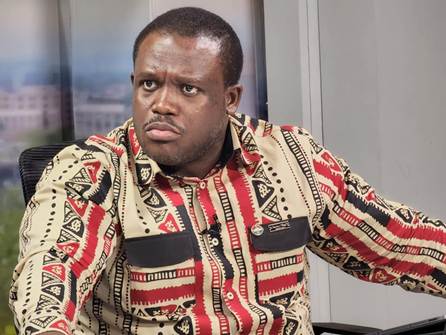
A growing public debate surrounding statements made by Ghana’s Minister for Communication, Digital Technology and Innovations, and Member of Parliament for Ningo-Prampram, Samuel Nartey George, regarding his legal qualifications in the United Kingdom has reignited national conversations about truth, integrity and accountability in public office.
The controversy, which has sparked widespread public discussion, raises broader questions about whether political leaders should be held to higher standards of accuracy when making public claims concerning personal achievements and professional credentials.
On May 6, 2026, reports published by Citinewsroom indicated that Mr George had attained a Master of Laws (LL.M.) in Professional Legal Practice from the University of Law in the United Kingdom.
The Minister reportedly stated that the qualification admitted him as a Solicitor of England and Wales, describing the achievement as a major professional milestone alongside his political career.
“I hope this inspires someone out there to pursue any dream that they have deferred. You never know what you can achieve until you start,” he was quoted as saying while expressing gratitude to family and friends for supporting him through the academic journey.
The announcement attracted widespread congratulations, particularly among supporters who interpreted the statement to mean the Minister had attained professional qualification to practise law in England and Wales.
However, the matter soon became the subject of public scrutiny after questions emerged regarding whether the academic qualification alone confers professional legal admission.
Academic Qualification Versus Professional Admission
Legal commentators and education analysts have pointed to an important distinction between earning an LL.M. in Professional Legal Practice and becoming a qualified solicitor in England and Wales.
While the degree is widely regarded as an important academic achievement and may prepare students for aspects of legal professional training, qualification as a solicitor typically requires satisfying additional regulatory conditions. These generally include passing the Solicitors Qualifying Examination (SQE), meeting practical work experience requirements and satisfying character and suitability standards regulated by legal authorities in the United Kingdom.
The distinction has become central to the public discussion.
Observers argue that if the public was led to understand that the Minister had fully qualified to practise law based solely on the degree, clarification may be necessary in the interest of transparency and public trust.
Public Office and the Burden of Truth
Political analysts say the issue transcends individual credentials and instead raises concerns about ethical leadership and truthfulness in governance.
In public office, words carry enormous influence. Statements by ministers and senior public officials often shape public perception and influence trust in institutions.
Analysts note that when claims made by public office holders are later questioned or found to be inaccurate, it can weaken confidence not only in the individual involved but also in the institutions they represent.
“In governance, credibility matters,” one governance expert noted. “Citizens may disagree with policies, but trust becomes difficult to rebuild once questions emerge over truthfulness.”
The matter also raises concerns about the example public officials set for younger generations.
Students and young professionals often look to political leaders as examples of achievement and perseverance. Critics argue that inaccurate or exaggerated claims, whether deliberate or inadvertent, risk promoting a culture where public image overshadows integrity.
Calls for Accountability
The debate has also generated calls for accountability, with some governance advocates insisting that public officials should not be exempt from standards expected of ordinary citizens.
Some observers argue that at a minimum, public clarification is required whenever statements made by leaders create confusion or are later disputed.
Others maintain that accountability should not necessarily be punitive but should instead focus on restoring public confidence through transparency and correction where necessary.
According to governance advocates, the issue is not merely about one political figure but about preserving standards in public leadership.
A Broader National Conversation
The controversy has ultimately evolved into a broader national conversation about ethics in leadership and the responsibilities attached to public office.
Questions continue to emerge: Should public officials be held to higher standards of truthfulness? Should influence excuse inaccuracies? And how should democratic societies respond when statements made by leaders become matters of public dispute?
Political observers say Ghana’s democratic progress depends not only on institutions and elections but also on public confidence in leadership.
For many, the debate serves as a reminder that in public life, credibility remains one of the most valuable forms of political capital.
As discussions continue, one principle appears increasingly difficult to dispute: truth matters in leadership, and public trust remains difficult to restore once questions of credibility emerge.
The public debate has also drawn attention to Mr George’s role beyond politics.
In addition to serving as Minister and Member of Parliament, Samuel Nartey George is widely known to hold a leadership role within Perez Chapel International, where he serves as an Elder.
For some observers, this dimension adds another layer to the discussion about public accountability and truthfulness. Religious leadership, like public office, is often associated with moral responsibility, personal integrity and public trust.
Governance and ethics analysts note that individuals who occupy influential positions in both politics and faith institutions are frequently held to heightened public expectations because of their influence on both civic and moral discourse.
Critics contend that public figures who occupy positions of spiritual and political leadership bear an even greater responsibility to ensure public statements are accurate and clearly communicated.
The broader issue, analysts say, is not simply about credentials but about the standards citizens expect from those entrusted with leadership—whether in government, religion or public life generally.