Says Africa must start building and stop talking
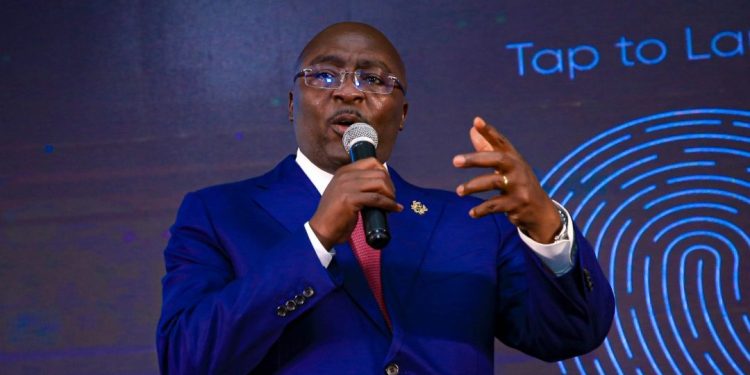
At a time when the world is racing ahead in artificial intelligence, Mahamudu Bawumia has delivered a blunt and uncompromising message: Africa risks being left behind again if it does not act decisively.
Speaking at the LSE Africa Summit 2026 hosted by the London School of Economics and Political Science, the former Vice President tore into what many see as the continent’s greatest weaknessendless discussion without execution.
“Technological revolutions reward those who build foundations,” he declared, warning that Africa cannot afford to chase trends without first fixing its fundamentals.
NO POWER, NO INTERNET — NO AI
Dr. Bawumia did not mince words. Without reliable electricity and broadband infrastructure, talk of AI leadership is nothing more than political fantasy.
Across large parts of Africa, erratic power supply and weak digital connectivity continue to cripple innovation. His message was clear: until governments fix these basics,
Africa will remain a consumer not a creator of AI technologies.
DATA IS THE NEW GOLD — BUT AFRICA IS UNPREPARED
In the AI economy, data is power. Yet Africa, he warned, lacks the secure and trustworthy systems needed to harness it.
Weak data protection, fragmented databases, and low public trust threaten to derail any serious AI ambitions. Without urgent reforms, Africa risks handing over its most valuable digital resource to foreign tech giants.
A CONTINENT WITHOUT SKILLS CANNOT COMPETE
Dr. Bawumia also delivered a stark warning on human capital: Africa is dangerously underprepared.
While other regions are producing armies of AI engineers and data scientists, Africa continues to lag behind. He called for aggressive, large-scale talent development programmes, insisting that the continent must build its own expertise or remain perpetually dependent.
GOVERNMENTS FAILING THE DIGITAL TEST
Perhaps most damning was his criticism of public sector capacity.
Many African governments, he argued, simply lack the technical competence to procure and deploy AI systems effectively. This opens the door to waste, corruption, and exploitation by external vendors.
Without reform, billions could be lost in poorly structured digital contracts.
BUILD AI — BUT BUILD IT RIGHT
On ethics, Dr. Bawumia struck a different tone—one of opportunity.
Africa, he said, has a chance to lead globally by embedding fairness, transparency, and accountability into AI systems from the ground up, avoiding the mistakes already seen in more advanced economies.
FRAGMENTATION IS AFRICA’S BIGGEST ENEMY
But his most strategic warning was reserved for Africa’s chronic disunity.
Fragmented markets, inconsistent regulations, and weak regional coordination continue to stifle innovation. He called for urgent cross-border collaboration to build interoperable digital systems that can scale across the continent.
Without this, Africa’s AI ambitions will remain small, isolated, and ineffective.
THE FINAL WARNING
Dr. Bawumia’s message was not wrapped in diplomacy—it was a wake-up call.
Africa stands at a crossroads. It can either build the infrastructure, skills, and institutions needed to compete in the AI era—or repeat the mistakes of past industrial revolutions and watch from the sidelines.
The choice, he made clear, is no longer theoretical.
It is immediate. It is urgent. And failure will be costly.