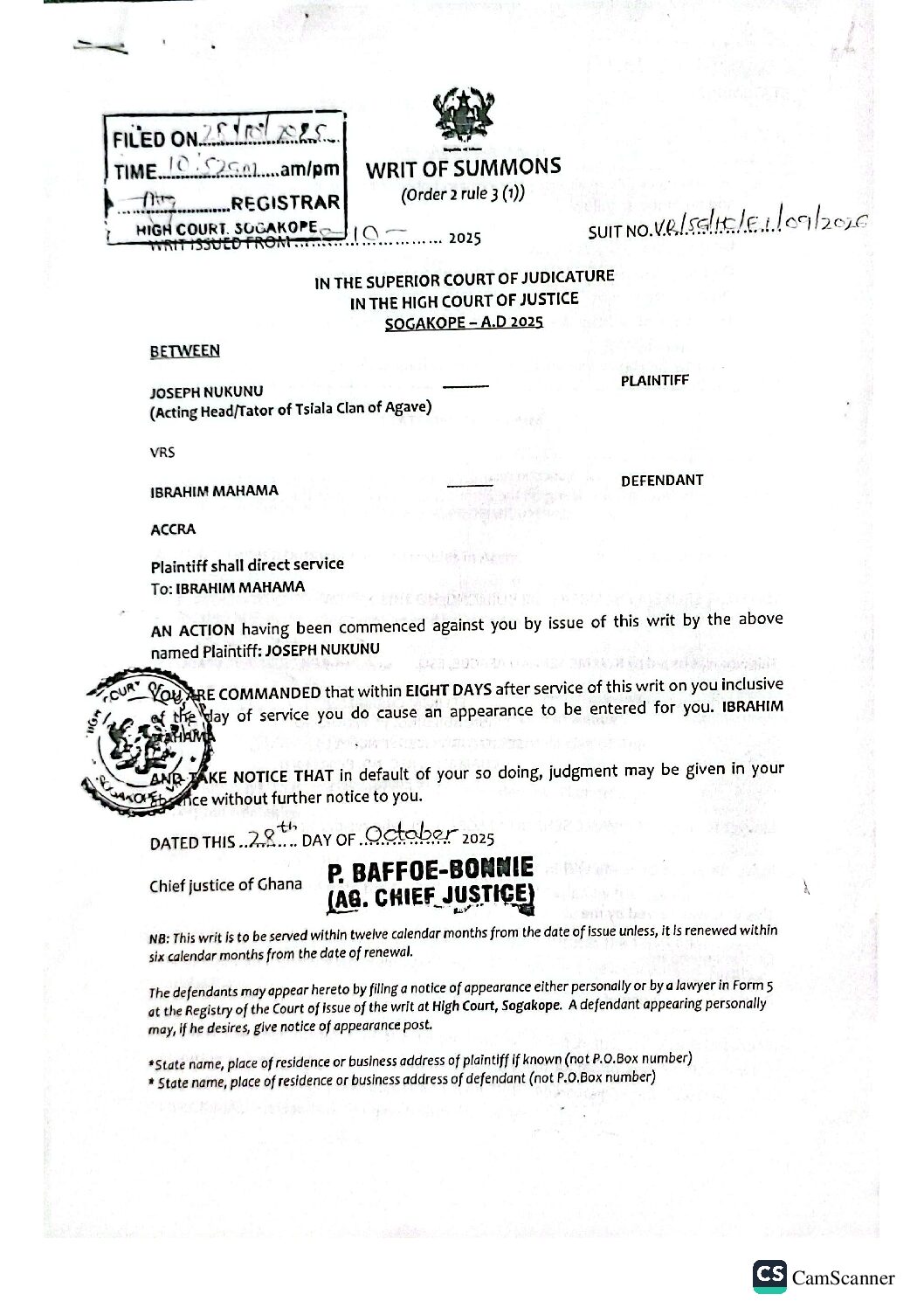
Tensions are mounting in the Agave Traditional Area of the South Tongu District following allegations that businessman Mr. Ibrahim Mahama has unlawfully taken over and cleared portions of the ecologically sensitive Anyigbe Clan lands for an oil palm plantation. The development, which is ongoing, has sparked outrage among affected families, environmental advocates, and traditional authorities, with the dispute now escalating toward full legal action.
The Head of the Anyigbe Clan, Togbe Lugu Awadali IV, has accused Mr. Mahama of entering the land without consultation or permission from the custodial authority, in what he describes as a blatant act of trespass and disregard for both customary law and a standing Supreme Court judgment.
Bulldozers on Ancestral Land
According to the complaint filed by Togbe Awadali IV, two individuals—Togbe Gbadawu IV and Kwadzovi Wodufia Agbo, both of Adutor—acted as agents for Mr. Mahama by facilitating the movement of bulldozers and supervising the clearing of large tracts of land.
The equipment reportedly razed several active family farmlands, including plots used for food crops and cash crops that sustain households within the clan. Residents say they woke up to the sound of heavy machinery destroying their livelihoods without any prior notice or consultation.
“This land belongs to the Anyigbe Clan, and no one—no matter how powerful—has the right to enter and destroy it without the consent of the clan head,” a representative of one of the affected families said.
Protected Wetland under Threat
The disputed area lies within a crucial ecological corridor bounded by Hlotor creek, Towutsi creek, Sonukpo, Agordome, and Agorve part of the wider KetaA vu Lagoon Ramsar Site, designated internationally for its biodiversity.
Environmentalists warn that the clearing has already impacted:
- The only known habitat of the endangered Sitatunga antelope in Ghana
- Sensitive wetland vegetation along streams and creeks
- The Core Zone, where human activity is traditionally restricted
- Night-time movement patterns essential for Sitatunga survival
“The destruction of creekside vegetation has cut off food sources for the Sitatunga,” a local conservation volunteer said. “Increased human presence and security personnel in the area will further endanger this already threatened species.”
The Ramsar site is legally protected, and any alteration requires environmental assessment and authorization from the Environmental Protection Agency (EPA)—none of which, the clan alleges, was done.
Supreme Court Judgment at the Centre of the Storm
A key element of the dispute is a Supreme Court ruling dated 19 July 2023, which confirms the Anyigbe Clan as the rightful owners of the land.
The clan contends that the ongoing development amounts to:
- Contempt of court,
- A violation of a settled land dispute, and
- A deliberate attempt to sidestep customary land tenure laws, which vest land administration in the clan head after consultation with constituent families.
Togbe Awadali IV has served written notice to Mr. Mahama, demanding an immediate halt to the operations. Copies of the Supreme Court judgment have also been served on the alleged accomplices.
Economic Losses Fuel Community Anger
A number of families say their farmlands—some cultivated for decades—have been destroyed to make way for the oil palm project. These farms include maize fields, cassava plots, vegetable gardens, and perennial crops that support household incomes.
“People depend on these lands to feed their children,” an affected resident lamented. “Now everything is gone, and no one has explained anything.”
The economic fallout is expected to be significant, with some families estimating the value of destroyed crops in the tens of thousands of cedis.
Case Escalates to Lawyers, Media, and Activist Groups
With land clearing reportedly ongoing, the Anyigbe Clan head says he is preparing to consult lawyers to initiate formal action. Environmental advocacy groups have also begun monitoring the situation and pushing for intervention by regulatory agencies.
The matter has attracted media attention, particularly because of the high-profile businessman at the centre of the controversy and the threat posed to a Ramsar-protected ecosystem.
Local leaders say the dispute threatens to destabilize community cohesion if not addressed swiftly and transparently.
Call for Government Action
Residents and traditional leaders are calling on the EPA, Lands Commission, Forestry Commission, Ministry of Lands and Natural Resources, and the South Tongu District Assembly to intervene immediately to halt the land-clearing exercise and investigate the legality of the acquisition.
“If nothing is done, we risk losing not just our land, but a globally significant ecological habitat,” one conservation advocate said.