
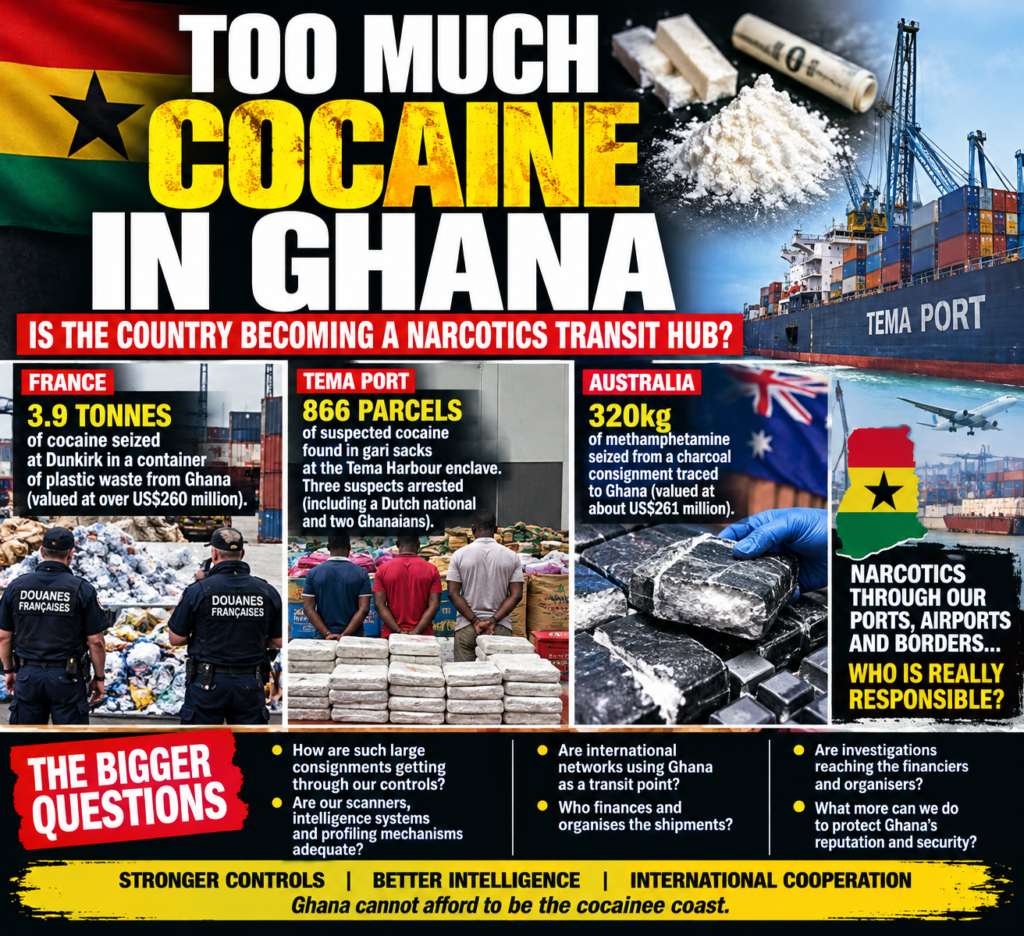
A massive cocaine seizure at Amsterdam Port has placed a shipment of wood from Ghana at the centre of a Dutch investigation into an increasingly sophisticated international trafficking network.
What appeared to be an ordinary shipment of wood arriving at the Port of Amsterdam concealed something far more sinister.
Inside the cargo, Dutch Customs discovered nearly 4,500 kilograms of cocaine—a haul so large that authorities described it as the biggest cocaine seizure ever recorded at the Port of Amsterdam.
The discovery on June 13 has opened a major investigation stretching across borders, companies and alleged front men, with Ghana emerging as a critical point in the journey of the shipment.
The sheer volume of cocaine has also renewed questions about how international criminal organisations exploit legitimate commercial supply chains to move narcotics into Europe.
The Ghana connection
The cocaine was concealed in a shipment of wood originating from Ghana and destined for a German company.
According to the Dutch Public Prosecution Service, the German company was allegedly being used as a front for international drug trafficking.
Investigators believe a 72-year-old man from Chaam, in Noord-Brabant, was used as a figurehead for the company. He allegedly received payment to register the business in his name.
But investigators were not satisfied with the identity of the person formally associated with the company.
A telephone investigation eventually led police to a 69-year-old man from Amsterdam, whom authorities suspect of involvement in the trafficking operation.
The man behind the phones
The Amsterdam suspect was arrested on October 5.
Police confiscated four mobile phones during the arrest as investigators sought to establish his alleged role in the operation, identify contacts and trace the movement of money.
The investigation illustrates the increasingly sophisticated methods used by law enforcement to penetrate international drug networks.
The 72-year-old figurehead and two other suspects have since been released. The Amsterdam suspect, however, remains in custody after a Dutch court extended his pre-trial detention to 90 days on October 20.
The Public Prosecution Service says the investigation is continuing and that additional arrests may follow.
From legitimate cargo to organised crime
The case offers a glimpse into how legitimate international trade can be exploited by organised criminal groups.
Timber, containers and other commercial goods move through international ports every day. For traffickers, authorities say, such cargo can provide an opportunity to conceal narcotics among legitimate products.
Dutch police say cocaine trafficking through ports is becoming increasingly professional.
Criminal organisations are reportedly using different forms of cargo to conceal cocaine and, in some cases, placing GPS tracking devices on containers.
Such technology can enable traffickers to monitor a container’s movements and identify its location when the drugs are eventually removed.
The sophistication of these operations means the battle against cocaine trafficking is no longer simply a matter of searching suspicious packages. It increasingly involves financial investigations, telecommunications analysis, company records, shipping data and international intelligence cooperation.
A port under pressure
Amsterdam’s latest seizure comes against the backdrop of enormous cocaine flows through Dutch ports.
The country’s biggest cocaine seizure occurred in 2023 at the Port of Rotterdam, when authorities intercepted more than 8,000 kilograms of cocaine.
The 4.5-tonne Amsterdam seizure is therefore smaller than the Rotterdam record but represents an unprecedented haul for Amsterdam’s port.
The investigation is being conducted by the HARC team in the North Sea Canal area, a specialist task force coordinated by the Amsterdam Public Prosecution Service.
It brings together Dutch Customs, the FIOD and the Police.
Beyond the seizure
For Ghana, the case carries significance beyond the quantity of cocaine involved.
The fact that the narcotics were concealed in a shipment of Ghanaian wood destined for Europe raises questions about the vulnerability of legitimate Ghanaian exports to exploitation by international criminal networks.
It is important, however, to distinguish the origin of the cargo from responsibility for the drugs. The seizure does not, by itself, establish that the Ghanaian timber exporter, Ghanaian authorities or legitimate businesses involved in the shipment knew about the cocaine.
That distinction will be critical as investigators attempt to reconstruct the entire supply chain—from the loading of the wood to its arrival in Amsterdam.
The bigger battle
The Amsterdam case demonstrates the scale and complexity of the international cocaine trade.
Nearly 4,500 kilograms of cocaine does not move from one continent to another through a single individual. It requires logistics, money, communications, transportation and access to legitimate commercial systems.
That is precisely why investigators are now examining phones, financial flows, companies and the relationships between the suspects.
The drugs may have been hidden inside wood.
But behind the timber is a much larger question: who organised the shipment, who financed it, who was meant to receive the cocaine, and how many other shipments may have travelled the same route undetected?
For investigators in the Netherlands, those questions now form the heart of a widening international probe.
And with the Dutch Public Prosecution Service anticipating further arrests, the 4.5-tonne Amsterdam seizure may prove to be not the end of the story,