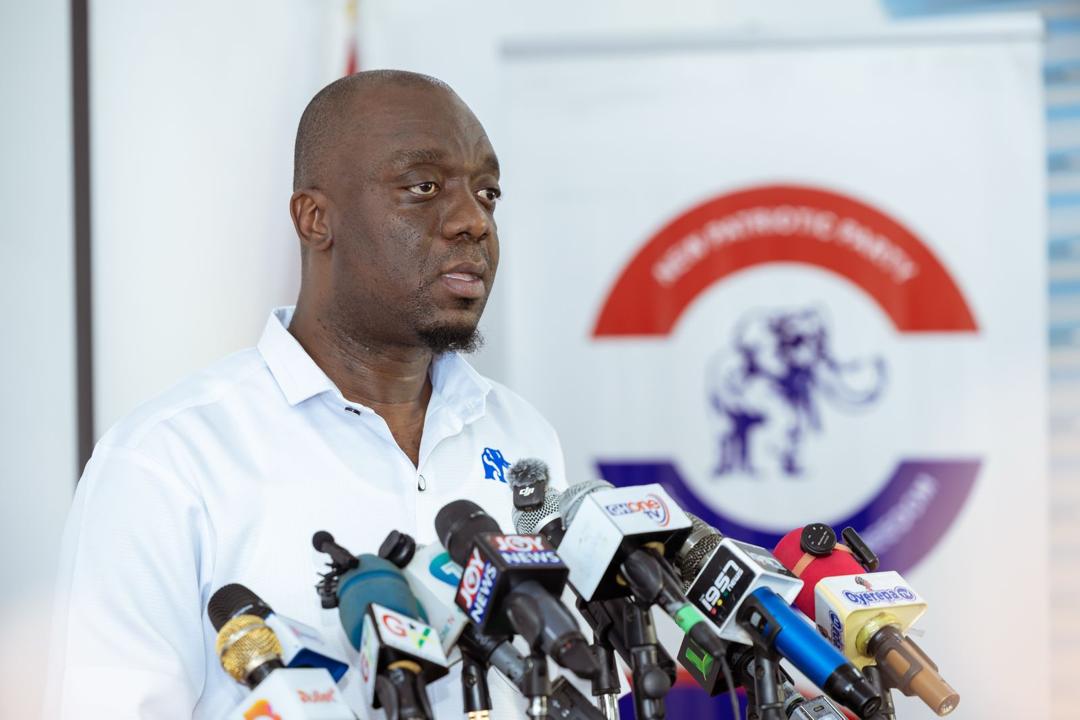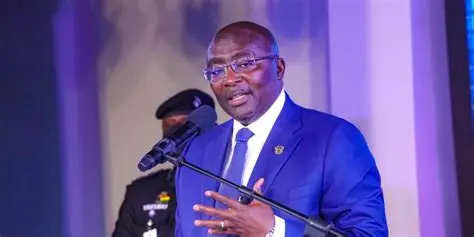
Dr. Mahamudu Bawumia has emerged as the clear front-runner in a new nationwide voter perception survey, opening a potentially significant new chapter in the race for Ghana’s 2028 presidency.
The survey, conducted by Africa Policy Lens (APL) between July 27 and August 7, 2026, places the New Patriotic Party (NPP) presidential candidate ahead of every one of seven potential National Democratic Congress (NDC) contenders tested in hypothetical head-to-head presidential contests.
The findings are striking not merely because Dr. Bawumia leads, but because he leads in every single matchup.
His national support ranges from 45.7 per cent to 49.9 per cent, depending on the NDC candidate.
The survey involved 16,963 respondents across all 276 constituencies and Ghana’s 16 regions, making it one of the largest nationwide political perception exercises cited in the report.
The findings put the former Vice-President ahead of:
- Dr Cassiel Ato Forson — 45.7% to 42.8%
- Johnson Asiedu Nketiah — 45.8% to 42.4%
- Haruna Iddrisu — 45.9% to 41.5%
- Prof. Naana Jane Opoku-Agyemang — 47.4% to 40.2%
- Dr Julius Debrah — 48.4% to 37.9%
- Hon. Eric Opoku — 49.8% to 33.9%
- Prof. Joshua Alabi — 49.9% to 34.4%
The report, however, cautions that the figures represent public opinion at the time of fieldwork and should not be interpreted as a prediction of the 2028 election outcome.
Perhaps the most consequential finding is the consistency of the Bawumia advantage.
In politics, a single poll can be dismissed as an outlier.
Seven consecutive hypothetical matchups pointing in the same direction are considerably harder to ignore.
According to APL, Dr. Bawumia records victories in between nine and eleven of Ghana’s 16 regions across the various candidate pairings.
That geographical breadth is particularly important in a country where presidential elections are won by building sufficiently broad national coalitions rather than relying solely on regional strongholds.
The report therefore suggests that Dr. Bawumia’s current support is not concentrated exclusively in the NPP’s traditional areas.
It describes his position as one of broad national competitiveness.
The poll also reveals that some potential NDC matchups could produce intensely competitive contests.
Against former NDC General Secretary Johnson Asiedu Nketiah, Dr. Bawumia records 45.8 per cent against 42.4 per cent.
The margin is only 3.4 percentage points.
Against Finance Minister Dr Cassiel Ato Forson, the gap is similarly narrow: 45.7 per cent to 42.8 per cent—a difference of 2.9 percentage points.
The contest against former Minister for the Interior Haruna Iddrisu is also competitive, with Dr. Bawumia polling 45.9 per cent against 41.5 per cent. These numbers make one thing clear:
In several scenarios, the undecided electorate could still significantly alter the political equation. The survey recorded 7.2 per cent undecided against Asiedu Nketiah, 7.5 per cent against Ato Forson and 8.1 per cent against Haruna Iddrisu.
For political strategists, those voters represent potentially decisive territory.The widest margins emerge against Prof. Joshua Alabi and Hon. Eric Opoku.
Against Prof. Alabi, Dr. Bawumia records 49.9 per cent, compared with 34.4 per cent for the NDC contender—a margin of 15.5 percentage points. Against Hon. Eric Opoku, the NPP candidate records 49.8 per cent, compared with 33.9 per cent, giving him a 15.9-point advantage.
Dr. Julius Debrah also trails significantly, with Dr. Bawumia polling 48.4 per cent against 37.9 per cent.
The results suggest that the identity of the NDC’s eventual presidential candidate could have a substantial bearing on the shape of the 2028 contest.
When voters were asked about the leadership qualities they most value in Ghana’s next President, honesty and integrity emerged as the number-one priority.
That was followed by: the ability to create jobs and competence in managing the economy. The finding creates a potentially powerful framework for the 2028 contest.
It suggests that Ghanaian voters are looking beyond traditional partisan loyalties and placing significant emphasis on two broad questions:
The job question is particularly significant in a country where unemployment, underemployment, business survival and household financial pressures remain central political issues.
The poll’s emphasis on economic competence could become one of the defining battlegrounds of the 2028 election. Dr. Bawumia has built much of his political profile around economic management, digitalisation, financial inclusion and technological transformation.
Consequently, the political battle is likely to move beyond personalities to competing economic records and promises.
Who can create jobs? Who can stabilise the economy? Who can protect the cedi? Who can improve household purchasing power? Who can attract investment? Who can reduce the cost of living?
Those questions could ultimately prove more decisive than campaign rhetoric.
16,963 VOICES FROM 276 CONSTITUENCIES
The methodology gives the survey considerable scale.
APL says its fieldwork covered all 276 parliamentary constituencies and all 16 administrative regions.
A total of 16,963 people were interviewed face-to-face.
The report states that the sample was designed using the 2024 Electoral Commission voter register, which it puts at 18,774,159 registered voters.
It says the survey employed a multistage probability sampling approach, with electoral areas selected using probability proportional to registered-voter populations, followed by random selection of polling stations and systematic respondent selection.
The respondents came from varied occupational and socioeconomic backgrounds, including farmers, traders, artisans, public servants, students, transport operators, unemployed persons and persons with disabilities.
APL says the achieved sample exceeded its stated minimum requirement for a 99 per cent confidence level and ±1 per cent margin of error.
These methodological claims make the survey worthy of serious examination.
But they do not make it infallible.
No poll can remove uncertainty from an election that is still years away.
The report raises an intriguing possibility.
It suggests that the current voter preferences may partly reflect public perceptions of the performance of the incumbent administration during its first two years.
That hypothesis was not directly tested by the survey.
Nevertheless, it raises a fundamental question for the governing NDC:
With more than two years remaining before the next presidential election, Ghana’s political parties are already confronting the central question of the 2028 contest.
The NPP has its candidate. The NDC does not.
And a new nationwide survey suggests that the NPP candidate currently has an advantage over every major NDC name tested. But beneath the headline lies a more nuanced political reality.
Dr. Bawumia is ahead The NDC is behind Millions of voters have yet to make their final choice.
And the issues that voters say matter most are integrity, jobs and economic competence will provide the battleground on which the next presidential contest is likely to be fought.
Dr. Mahamudu Bawumia is currently in pole position against every NDC contender tested.
His support reaches nearly half of the electorate in several scenarios and extends into a majority of Ghana’s regions.
That makes him, at this moment, a formidable 2028 contender.