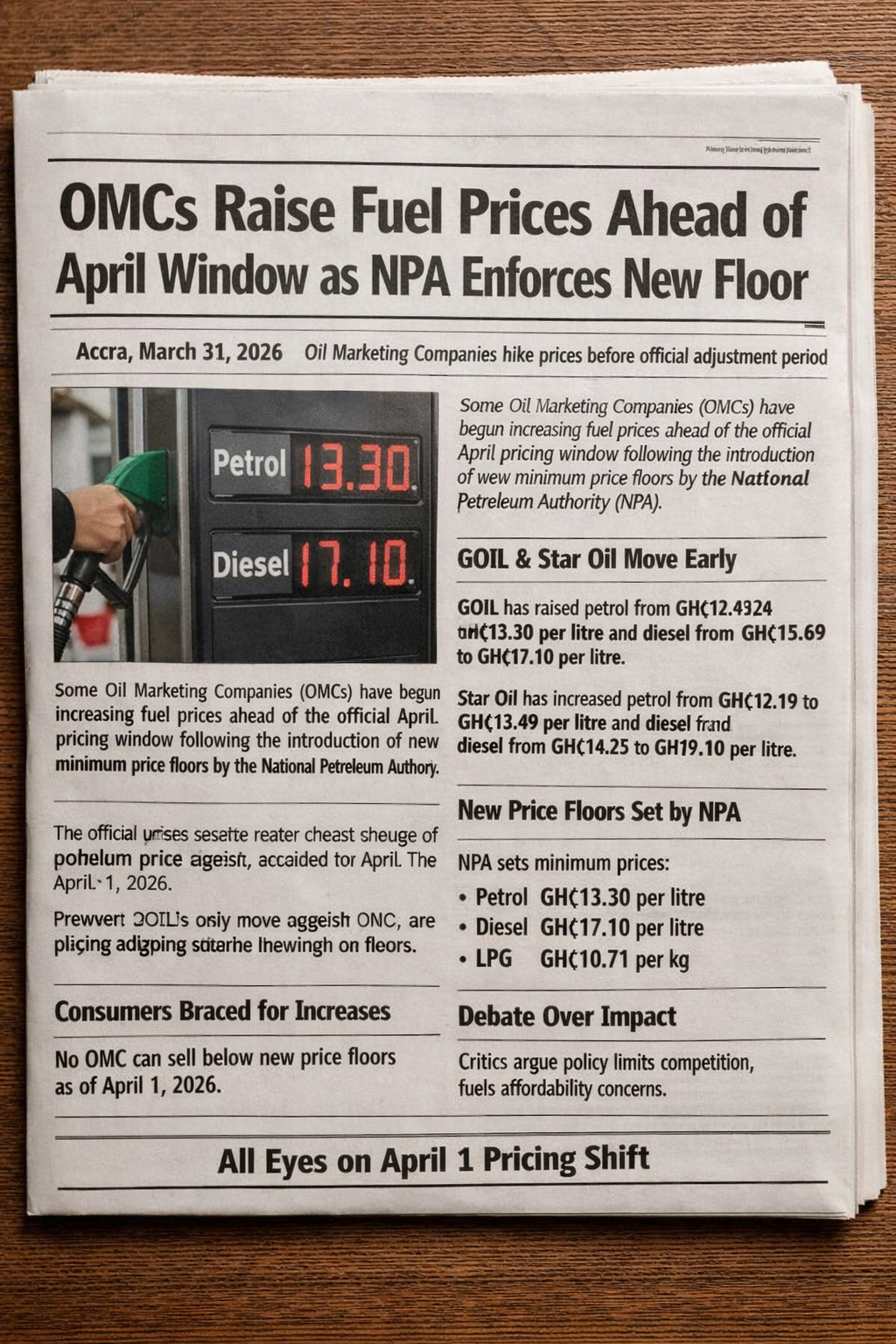
Some Oil Marketing Companies (OMCs) have increased fuel prices ahead of the official April pricing window, following the introduction of new minimum price floors by the National Petroleum Authority (NPA).
Leading industry player Ghana Oil Company (GOIL) announced that petrol prices have risen from GH¢12.24 to GH¢13.30 per litre, while diesel has increased from GH¢15.69 to GH¢17.10 per litre. The company indicated in a social media post that the adjustments were influenced by the NPA’s revised price floor directive issued on March 30, 2026.
The official pricing window under Ghana’s deregulated petroleum pricing regime is scheduled for April 1 to April 15, 2026. However, GOIL’s early move suggests OMCs are already aligning with the new regulatory thresholds.
Another major player, Star Oil, has also implemented price increases effective 8:00 a.m. on March 31. Petrol prices have gone up from GH¢12.19 to GH¢13.49 per litre, while diesel has risen from GH¢14.25 to GH¢17.97 per litre.
New Price Floors Introduced
In a circular dated March 30, the NPA announced revised minimum price floors for petroleum products for the upcoming pricing window. The new floors are as follows:
- Petrol: GH¢13.30 per litre (up from GH¢11.57)
- Diesel: GH¢17.10 per litre (up from GH¢14.35)
- Liquefied Petroleum Gas (LPG): GH¢10.71 per kilogram (up from GH¢10.67)
The directive requires all OMCs and LPG Marketing Companies to comply strictly with the set minimum prices.
According to the NPA, the price floors exclude premiums charged by International Oil Trading Companies, as well as the operating margins of Bulk Import, Distribution and Export Companies (BIDECs) and OMCs, which are determined independently.
Implications for Consumers
From April 1, no OMC or LPG Marketing Company will be permitted to sell fuel below the approved price floors. Companies currently pricing below these levels are required to adjust immediately.
As a result:
- Petrol cannot be sold below GH¢13.30 per litre
- Diesel cannot be sold below GH¢17.10 per litre
The development is expected to lead to uniformity in fuel pricing across the market, with all major OMCs likely to align with the new thresholds.
Industry Outlook
While the NPA maintains that the price floor is necessary to ensure stability within the petroleum downstream sector, some industry players have argued that the policy limits competitive pricing, which could otherwise offer consumers some relief.
With the new pricing regime set to take full effect from April 1, consumers are expected to experience higher fuel costs in the coming weeks as OMCs adjust to the revised framework.