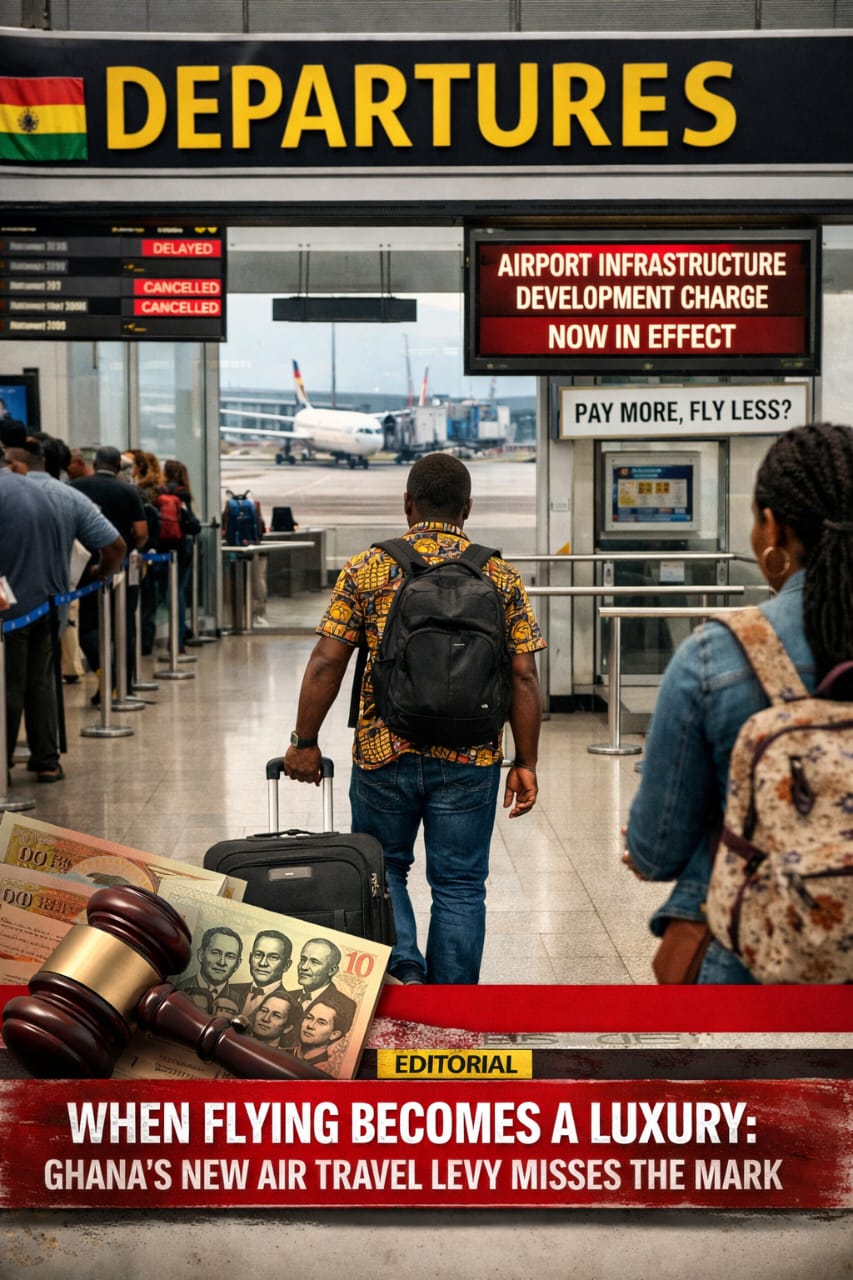
Government’s decision to impose an Airport Infrastructure Development Charge on air travel may be dressed in the language of progress, but beneath the policy lies a troubling7 reality: once again, the burden of fixing systemic inefficiencies is being shifted onto the ordinary Ghanaian.
From today, every passenger passing through Kotoka International Airport and other airports across the country will pay more whether they can afford it or not. The justification? To fund infrastructure upgrades and modernise Ghana’s aviation sector.
It sounds reasonable. It even sounds necessary. But it is also deeply problematic.
A TAX BY ANOTHER NAME
Let’s call this what it is: a tax. Not a voluntary contribution, not a sectoral adjustment—a tax on mobility. And like many such levies before it, it comes at a time when Ghanaians are already grappling with rising fuel prices, inflationary pressures, and a cost-of-living crisis that shows little sign of easing.
Government insists the increase will be “marginal.” But marginal to whom? For the business traveler, perhaps it is negligible. For the average Ghanaian struggling to afford a ticket in the first place, it is yet another barrier.
Public policy must be measured not by its intent, but by its impact.
THE ACCOUNTABILITY DEFICIT
More worrying is the familiar question: where will the money go?
Ghanaians have heard this promise before—levies introduced in the name of development, only for outcomes to fall short of expectations. Without a transparent, independently monitored framework for managing these funds, the Airport Infrastructure Development Charge risks becoming just another revenue stream swallowed by inefficiency.
If government expects public buy-in, it must go beyond rhetoric. It must publish clear benchmarks, timelines, and audited accounts showing exactly how every cedi collected is spent.
Anything less will fuel suspicion—and rightly so.
MISPLACED PRIORITIES
There is also a fundamental policy question at stake: why must infrastructure development rely on squeezing more from users instead of addressing waste, corruption, and inefficiencies within existing systems?
Ghana’s aviation sector is not short of revenue streams. Passenger service charges, taxes, and fees already form a significant portion of ticket prices. Adding yet another layer suggests not innovation, but a failure to manage what already exists.
Development cannot be built on a foundation of perpetual extraction.
COMPETITIVENESS AT RISK
Beyond domestic concerns, the levy carries implications for Ghana’s position in the regional aviation market. West Africa is increasingly competitive, with countries vying to become preferred transit hubs.
Higher travel costs could deter airlines and passengers alike, pushing traffic to more cost-efficient destinations. The ambition to make Ghana a regional aviation hub cannot coexist with policies that make it more expensive to fly in and out of the country.
It is a contradiction that policymakers cannot afford to ignore.
A BETTER WAY FORWARD
No one disputes the need for improved airport infrastructure. Safe runways, modern terminals, and efficient passenger systems are not luxuries—they are necessities.
But the question is not whether to invest. It is how.
A more credible approach would involve public-private partnerships, stricter financial discipline, and the elimination of leakages within existing revenue channels. Above all, it would require leadership willing to make difficult decisions about spending—not just easy decisions about charging.
THE VERDICT
The Airport Infrastructure Development Charge may take effect today, but its legitimacy will be tested over time.
If it delivers visible, measurable improvements, it may yet win public acceptance.
If it does not, it will join the long list of well-intentioned policies that ultimately became symbols of misplaced priorities and broken trust.
For now, one thing is certain: in Ghana today, even the act of flying is becoming more expensive—not because it must be, but because it is easier to charge than to reform.