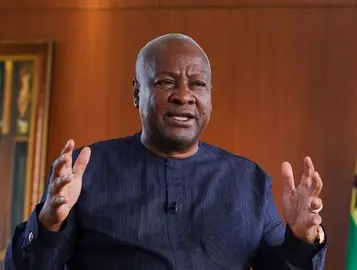
The National Democratic Congress (NDC) government led by President John Dramani Mahama has come under intense criticism after reducing the cocoa farm-gate price from GH₵3,600 to GH₵2,587 per bag — a sharp cut that contradicts its 2024 campaign promise to increase the price to GH₵6,500.
While in opposition, the NDC accused the then NPP government of “cheating cocoa farmers” and pledged to dramatically raise producer prices to reflect global market realities. Today, however, cocoa farmers are facing a significant reduction instead of the promised increment.
The New Price Regime
Finance Minister Dr. Cassiel Ato Forson, speaking on Thursday, February 12, announced that the Producer Price Review Committee (PPRC) had revised the producer price for the remainder of the 2025/2026 crop season.
According to him:
Farmers will receive 90% of the achieved gross FOB price of USD 4,200 per tonne.
The new price is GH₵41,392 per tonne.
This translates to GH₵2,587 per bag.
The directive takes effect immediately.
Dr. Forson explained that the decision was necessary due to falling international cocoa prices and aimed at injecting liquidity into the sector to ensure prompt payment of farmers.
Promise vs. Reality
The controversy, however, lies in the political contrast:
2024 Campaign Promise: Increase farm-gate price to GH₵6,500 per bag.
2026 Reality: Reduced price to GH₵2,587 per bag.
For many cocoa farmers, this represents not just an economic adjustment but a political reversal.
Government’s Justification
The Finance Minister argues that:
Global cocoa prices have declined.
The adjustment reflects international market conditions.
The move ensures sustainability of the cocoa sector.
Immediate liquidity is required to support operations.
By pegging the producer price at 90% of the FOB value, the government says it is protecting farmers within the constraints of the global market.
The Bigger Question
Critics ask:
If global prices have declined, why was GH₵6,500 promised in 2024?
Were the campaign projections unrealistic?
Could COCOBOD inefficiencies be contributing to the pricing pressures?
Is this an economic necessity — or a political miscalculation?
For thousands of cocoa farmers already battling high fertilizer costs, labour shortages, and inflation, the reduction may deepen financial strain.
Political Implications
Cocoa remains the backbone of Ghana’s rural economy. Any major change in pricing carries serious political consequences, especially in cocoa-producing regions that influence electoral outcomes.
The NDC government insists the move is responsible and market-driven.
But for many farmers, the question remains: Was the promise of GH₵6,500 a genuine commitment — or campaign rhetoric?