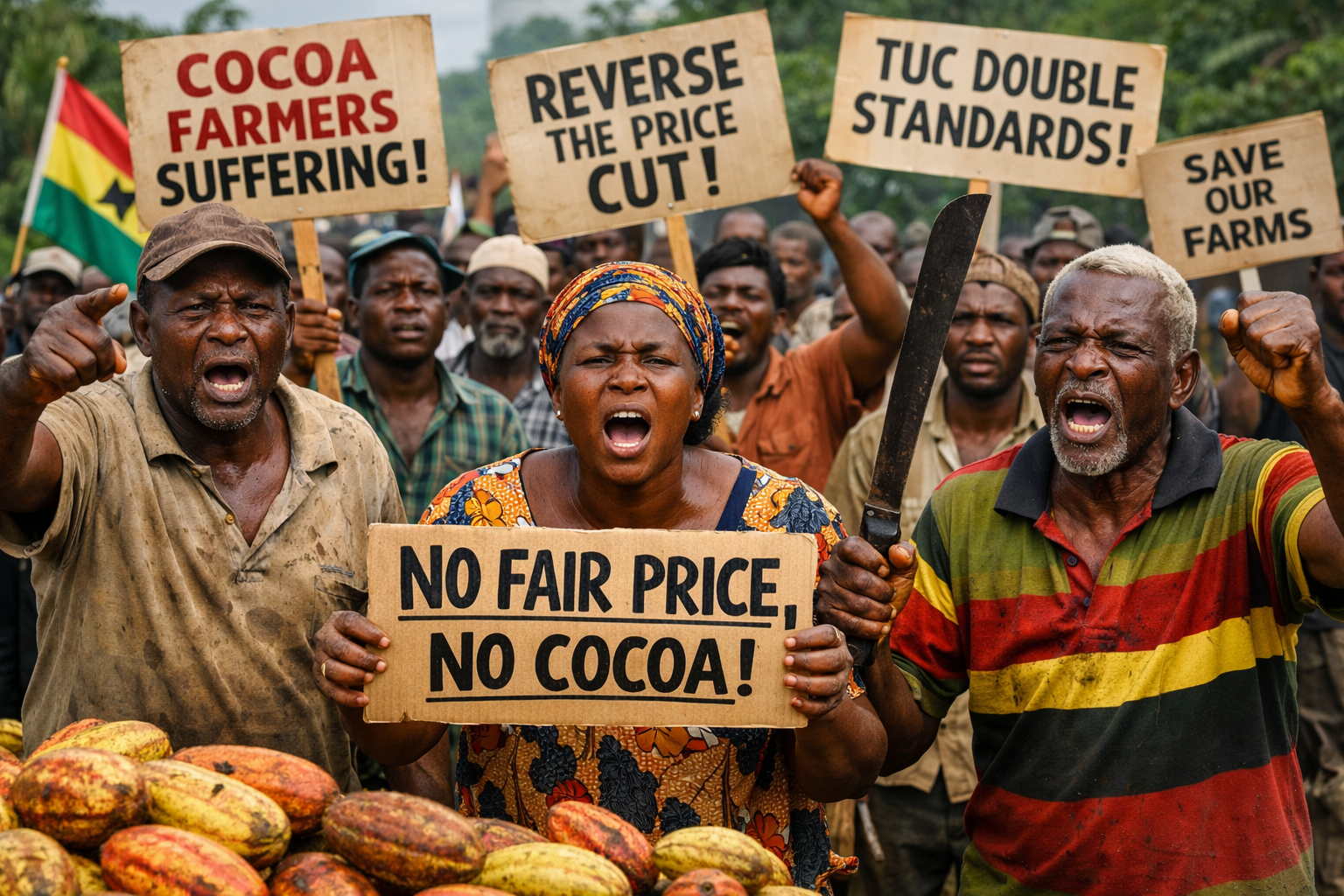
Cocoa farmers across Ghana are reeling from a fresh reduction in producer prices, a move that has triggered widespread anger in farming communities and reignited debate over government’s commitment to protecting grassroots incomes.
The latest adjustment has hit growers in major cocoa belts particularly hard, with many describing the decision as ill-timed and economically punishing amid rising costs of fertiliser, agrochemicals, labour and transportation.
Farmers argue that while inflation continues to erode purchasing power, a downward review of cocoa prices further tightens the squeeze on households whose survival depends almost entirely on proceeds from the crop. In key producing areas such as the Ashanti Region and the Western North Region, concerns are mounting that the cut could deepen rural hardship and discourage investment in cocoa farms.
Beyond the farms, the decision has sparked a broader national conversation about wage policy and income protection. Critics point to what they describe as an inconsistency by the Trades Union Congress (TUC), which previously rejected a 23 percent salary increment under former President Nana Akufo-Addo as inadequate, but later accepted a 10 percent adjustment under President John Dramani Mahama.
For many observers, the issue goes beyond organised labour. They argue that if formal sector workers can be persuaded to settle for lower salary increments — despite pensions being calculated on earnings during active service — then cocoa farmers, whose incomes are directly tied to state-determined producer prices, may be left even more vulnerable.
Economic analysts warn that sustained dissatisfaction within the cocoa sector could carry long-term national consequences. Ghana’s cocoa industry remains a critical foreign exchange earner and a pillar of rural employment. Any erosion of farmer confidence, they caution, risks reduced farm maintenance, lower productivity, and potential migration of labour to other sectors.
Stakeholders are therefore urging policymakers to balance fiscal considerations with the urgent need to sustain farmer morale and protect rural livelihoods. As pressure mounts, attention is turning to whether government will revisit the pricing decision or introduce mitigating measures to cushion farmers from the economic fallout.
For many cocoa growers, however, the message is clear: without fair and predictable producer prices, the backbone of Ghana’s agricultural economy stands on uncertain ground.