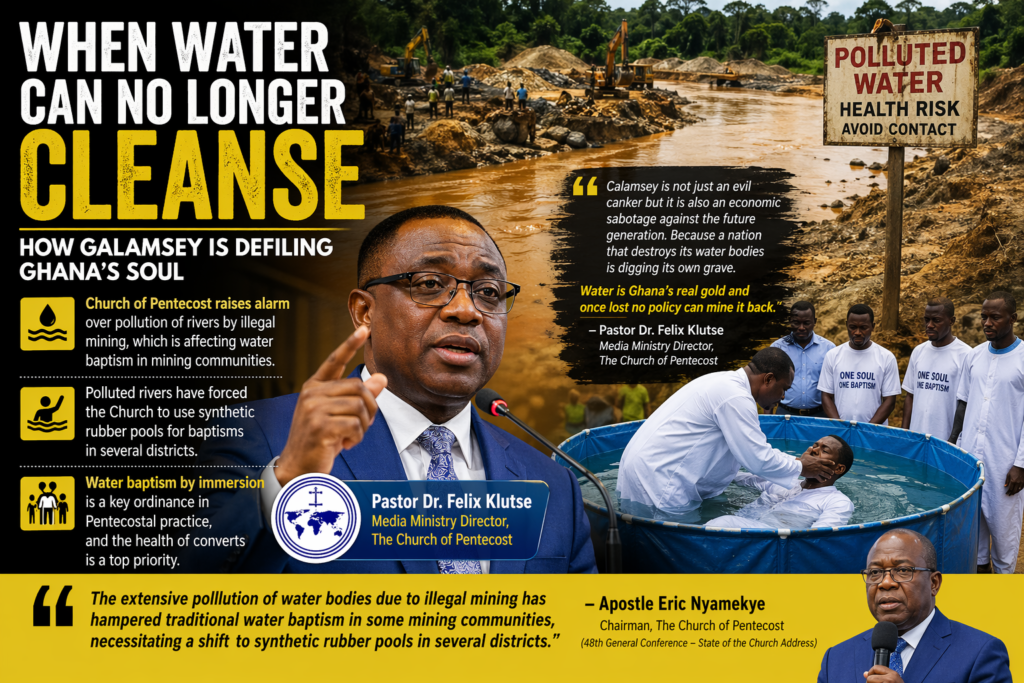
Ghana’s illegal mining crisis galamsey has crossed yet another disturbing line. It is no longer confined to poisoned rivers, destroyed farmlands, and lost livelihoods. It has now invaded the sacred.
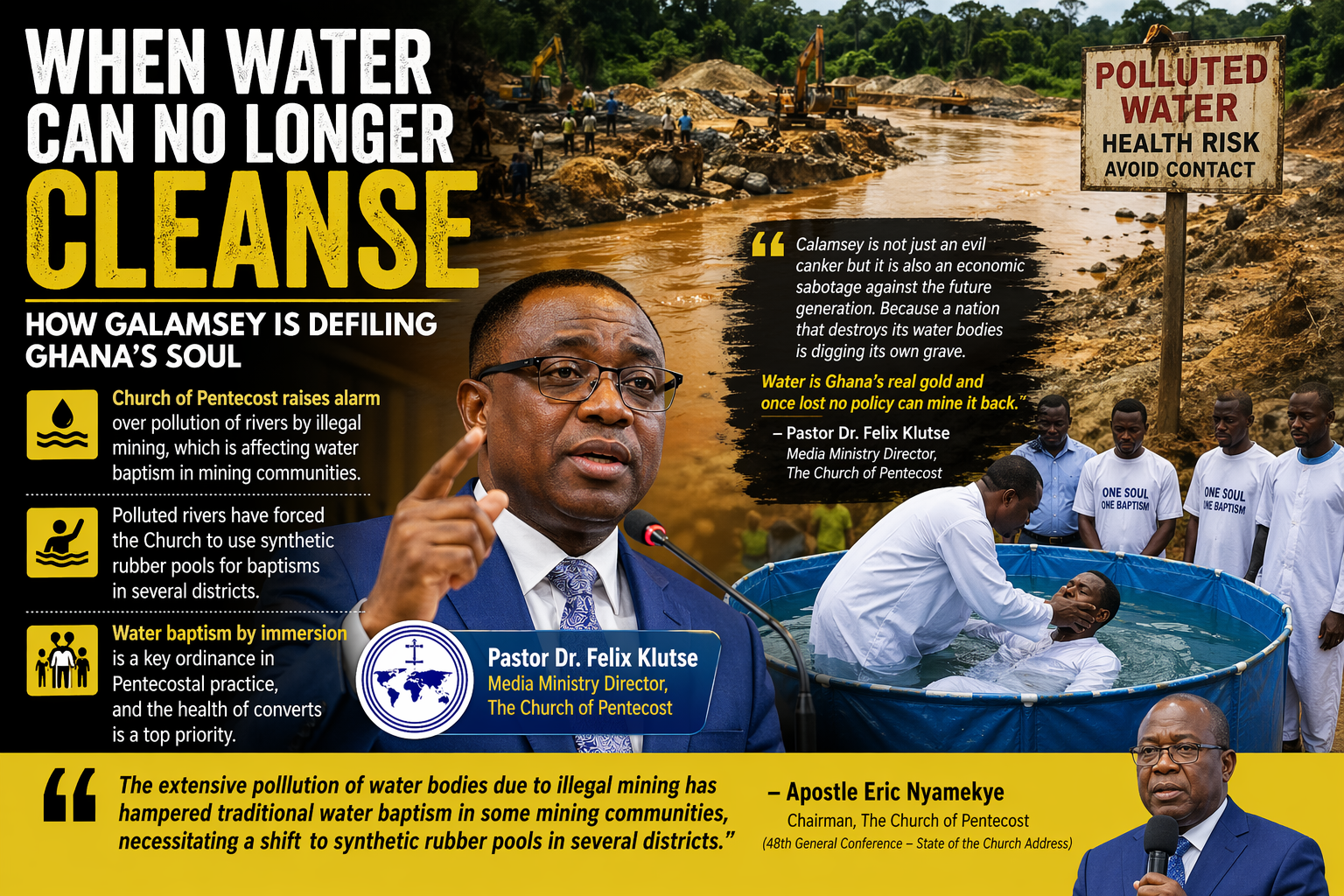
At the 48th General Conference of The Church of Pentecost, its Chairman, Apostle Eric Nyamekye, delivered a sobering truth: polluted rivers have made it unsafe to perform water baptism in several communities. In response, the Church has been forced to resort to synthetic rubber pools to carry out one of Christianity’s most symbolic rites.
Pause and reflect on that.
A country that prides itself on deep spirituality has allowed its natural baptismal waters to become too toxic for the very act that symbolizes spiritual cleansing. If that is not a national paradox, what is?
Water baptism is not merely ritual. It is theology in action—an immersion into purity, a public declaration of faith, a sacred encounter between the human soul and creation. Rivers have always been central to that symbolism. But today, those same rivers—once life-giving are choked with mercury, mud, and greed.
What we are witnessing is not just environmental degradation. It is a quiet but profound spiritual dislocation.
The implications are far-reaching.
First, this is an indictment of leadership. For years, successive governments have declared war on galamsey. Yet the destruction continues often in plain sight, sometimes under the protection of powerful interests. If rivers critical to human survival and religious practice can be destroyed with such impunity, then the enforcement regime is not just weak it is compromised.
Second, it exposes a moral contradiction within society itself. Churches are filled every week. Prayers are loud. Faith is professed boldly. Yet, in the same communities, the environment that sustains both life and worship is being desecrated. We cannot claim devotion to God while destroying the very creation that reflects His glory.
Third, the economic undercurrent cannot be ignored. As Apostle Eric Nyamekye noted, cocoa farmers are battling declining yields due to erratic rainfall, while fisherfolk are forced into seasonal migration as water bodies deteriorate. These are not abstract statistics—they are lived realities that are eroding incomes, destabilizing families, and weakening the financial backbone of local church assemblies.
In short, galamsey is no longer just an environmental crisis. It is an economic crisis. A social crisis. And now, undeniably, a spiritual crisis.
The image of a church replacing a river with a rubber pool should haunt this nation.
It should haunt policymakers who have failed to act decisively.
It should haunt traditional authorities who have looked away.
It should haunt citizens who benefit directly or indirectly from this destruction.
Because when a nation loses the purity of its waters, it risks losing the purity of its conscience.
This is the moment for clarity and courage.
The fight against galamsey must move beyond slogans and sporadic crackdowns. It requires sustained, depoliticized enforcement, real accountability for offenders no matter how powerful and a genuine commitment to restoring degraded lands and rivers. Anything less is complicity.
Ghana must decide: will we protect what sustains us, or will we continue to sacrifice our future and now even our faith on the altar of short-term gain?
Because if rivers can no longer baptise, then something far deeper than water has been polluted.