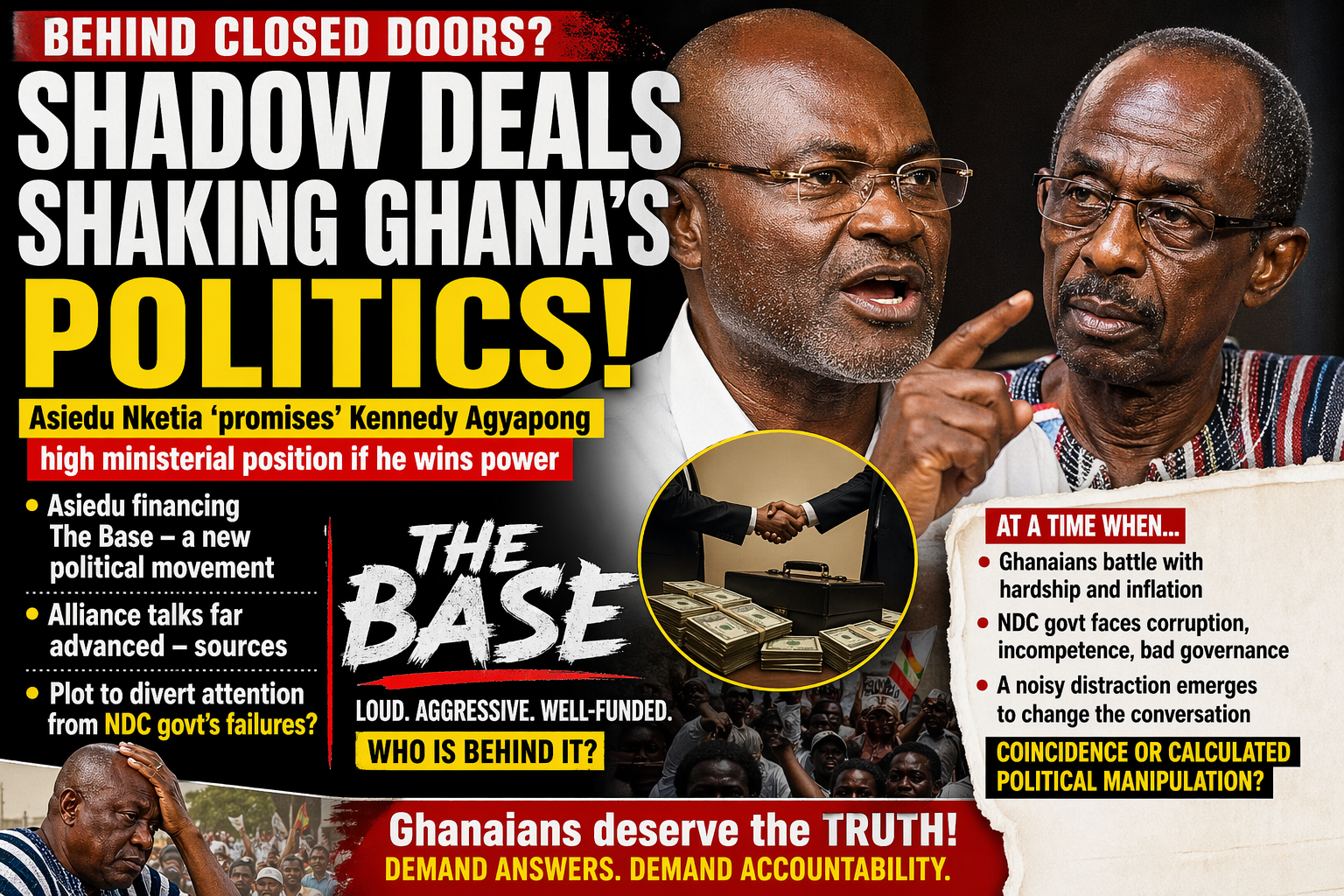
Ghana’s Politics is no stranger to intrigue, but the latest whispers surrounding Kennedy Agyapong and Johnson Asiedu Nketia raise troubling questions that cannot be ignored.
Are we witnessing the quiet construction of a political alliance the public is not meant to see?
For decades, Ghana’s democracy has thrived however imperfectly on ideological contest and party loyalty. Yet today, credible murmurs within political corridors suggest something far more transactional may be at play: cross-party engagements, strategic positioning, and the possible trading of future power for present convenience.
If these reports hold even a grain of truth, then the implications are profound.
What would it mean for a prominent figure long associated with one political tradition to suddenly find common cause with a leading force in the National Democratic Congress? What does it say about the integrity of our political system if backroom negotiations rather than public mandate begin to shape the future leadership of this country?
Even more concerning are the growing conversations around a shadowy political movement known as “The Base.” Loud, disruptive, and increasingly visible, the group appears determined to insert itself into the national conversation. But to what end? Who funds it? Who benefits from its noise?
Ghanaians deserve answers.
This is not just about personalities. It is about principle. It is about transparency. And it is about whether political power in this country is being negotiated behind closed doors while citizens are fed carefully curated narratives.
At a time when the National Democratic Congress government faces mounting criticism over governance, economic strain, and leadership concerns, the sudden rise of distracting political theatrics cannot be dismissed as coincidence. Whether by design or default, such developments risk diverting national attention from the real issues affecting ordinary Ghanaians.
Let it be clear: democracy does not die only through coups or constitutional breaches. It can also be eroded quietly through opaque alliances, unaccountable influence, and political opportunism dressed up as strategy.
If there is nothing to hide, then those at the center of these swirling claims must come forward and speak plainly.
Ghanaians are watching. And silence, in moments like this, only deepens suspicion.