In Ghana’s high-stakes political arena, the most consequential moves are often not made on campaign platforms or parliamentary floors but in quiet meetings, private conversations, and alliances the public is never meant to see.
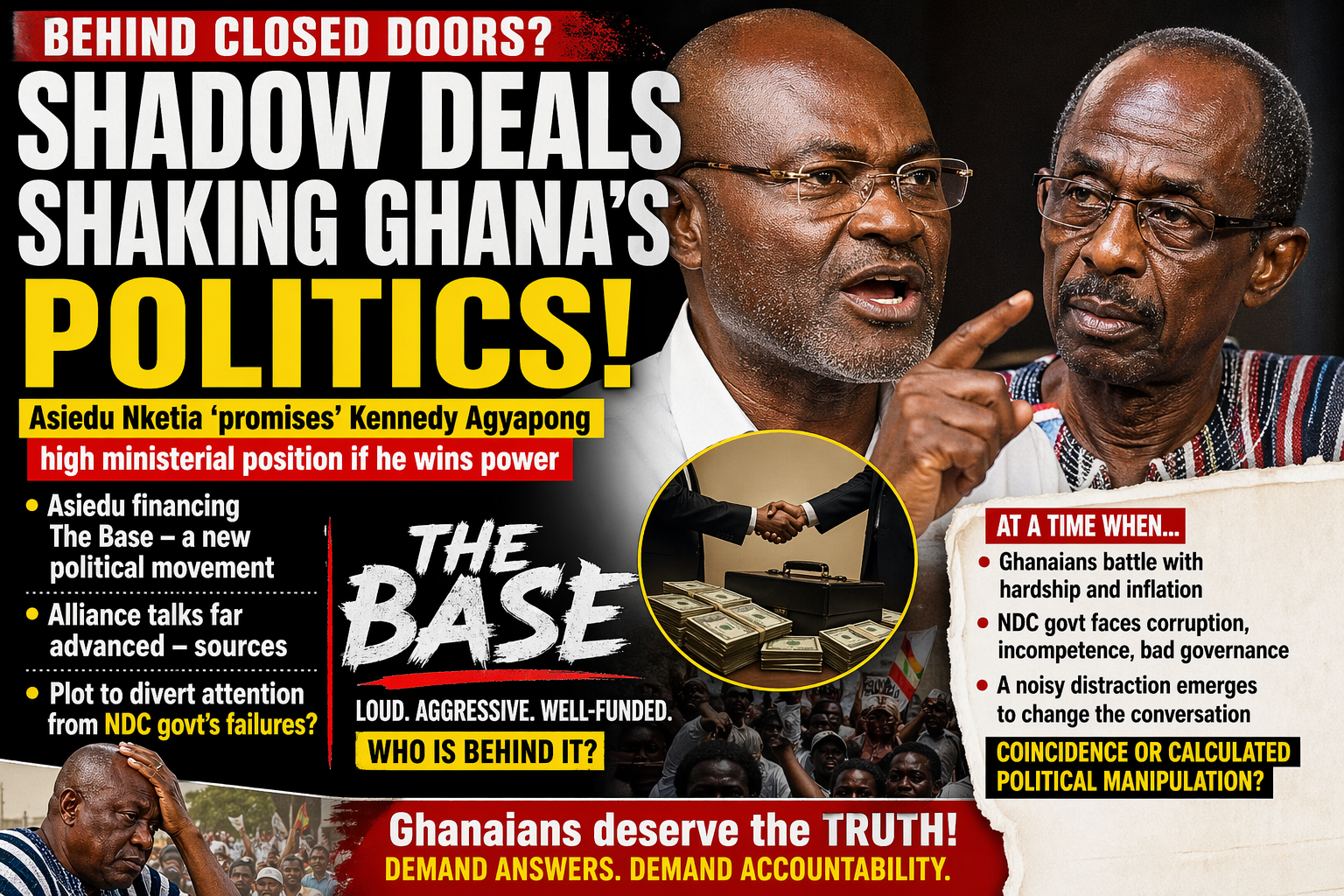
That is why recent murmurs surrounding Kennedy Agyapong and Johnson Asiedu Nketia have ignited intense speculation across the country’s political landscape.
There is no official announcement. No formal handshake captured on camera. Yet, within political circles, talk of a possible understanding however informal refuses to go away.
Is this mere political gossip? Or the early signs of a strategic realignment that could reshape Ghana’s electoral future?
Politics Beyond Party Lines
For years, Ghana’s democracy has been defined by strong partisan divides, particularly between the National Democratic Congress and its main rivals. Figures like Kennedy Agyapong have built reputations on bold, often uncompromising positions within that divide.
Which is precisely why any suggestion of cross-party engagement even at a strategic level raises eyebrows.
Political analysts note that in mature democracies, alliances across ideological lines are not uncommon. But in Ghana, where party identity is deeply entrenched, such a shift if confirmed would signal something far more calculated than casual engagement.
“It would mean politics is becoming less about ideology and more about access to power,” one Accra-based observer noted.
The Mystery of “The Base”
Compounding the intrigue is the emergence of a relatively new and increasingly vocal political movement known as “The Base.”
Almost overnight, the group has inserted itself into national discourse loud, confrontational, and unapologetically disruptive. Its messaging has sparked debate, drawn attention, and, in some quarters, suspicion.
Who is behind it?
That question remains unanswered.
What is clear, however, is that “The Base” is not behaving like a typical grassroots movement. Its coordination, messaging discipline, and sudden visibility have led some observers to speculate that it may be backed by interests operating beneath the surface of mainstream politics.
No direct evidence has been publicly presented linking the group to any established political figures. Yet the timing of its rise and the nature of its interventions has only fueled further questions.
Distraction or Strategy?
All of this is unfolding against the backdrop of growing public frustration with governance challenges. The National Democratic Congress administration continues to face criticism over economic pressures, leadership decisions, and policy direction.
In such an environment, the sudden dominance of speculative political narratives invites scrutiny.
Is the noise organic? Or is it serving a purpose?
Some analysts argue that in politics, distraction is often as powerful as policy. Shifting public focus intentionally or otherwise can buy time, reshape narratives, and dilute criticism.
Others caution against overinterpretation, insisting that Ghana’s political space has always been fertile ground for rumours, especially as elections approach.
The Stakes for Democracy
At its core, this moment is not just about two individuals or one emerging movement. It is about the health of Ghana’s democratic process.
If political alliances are being explored behind closed doors, the public has a right to know the principles guiding those discussions. If new movements are entering the scene, transparency about their origins and objectives becomes essential.
Democracy thrives on openness—not opacity.
The danger is not merely that alliances may exist. It is that they may exist without accountability.
Silence and Speculation
So far, those at the centre of these swirling claims have remained largely silent.
But in politics, silence is rarely neutral.
It creates space—for speculation, for suspicion, and for narratives that may or may not reflect reality.
For a politically aware and increasingly discerning Ghanaian public, that silence is no longer enough.
The Questions That Remain
Are these rumours baseless?
Is “The Base” an independent force or something more strategic?
And are unseen alliances quietly redefining Ghana’s political future?
Until clear answers emerge, one thing is certain: beneath the surface of Ghana’s democracy, something is shifting.
Whether it is evolution—or erosion—will depend on what comes to light next.