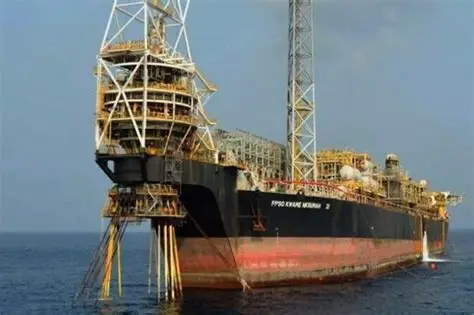
When Ghana discovered oil in commercial quantities in 2007, the promise was transformative. Oil was expected to stabilise public finances, deepen industrialisation and insulate the economy from shocks. Nearly two decades on, the country’s latest crude oil revenue figures suggest a far more complicated reality.
According to the Bank of Ghana’s Semi-Annual Petroleum Funds Report, Ghana’s crude oil lifting receipts plunged to US$198.25 million in the second half of 2025, down sharply from US$369.25 million over the same period in 2024. The nearly 46 per cent decline raises difficult questions—not just about global oil prices, but about production reliability, revenue predictability, and long-term fiscal planning.
The Immediate Numbers Mask Deeper Fault Lines
On the surface, the explanation appears straightforward: fewer liftings and lower prices. Between July and December 2025, government lifted only three crude oil cargoes—two from the Jubilee Field and one from the Sankofa Gye Nyame (SGN) Field. A cargo from the Tweneboa Enyenra Ntomme (TEN) Field valued at US$60.79 million, expected in November, failed to materialise before year-end and was excluded from the figures.
Receipts from Jubilee accounted for US$134.55 million, while SGN contributed US$63.70 million. But beneath these numbers lies a more troubling pattern: Ghana’s oil revenue stream remains highly exposed to both operational disruptions and market swings, with limited buffers beyond accumulated savings.
Production Constraints and the Question of Reliability
Industry observers note that Ghana’s major producing fields are no longer in their early, high-yield years. Jubilee, TEN and SGN are mature assets, increasingly vulnerable to maintenance shutdowns, technical delays and production declines. Deferred liftings—such as the missing TEN cargo—may appear minor in isolation, but collectively they create unpredictability in government cash flows.
For a budget system that depends on scheduled petroleum receipts to support statutory transfers, infrastructure funding and energy sector obligations, such delays can complicate fiscal execution.
More critically, the lack of public clarity around the causes of deferred liftings often leaves analysts guessing whether disruptions are purely technical or symptomatic of deeper operational challenges.
Global Prices: A Factor Ghana Cannot Control
The global oil market offered little relief in the second half of 2025. Brent crude prices slid from US$66.61 per barrel at the end of June to US$60.81 by December, reflecting softer demand growth, rising non-OPEC supply and lingering geopolitical uncertainty.
For Ghana, this price movement translated directly into weaker earnings per cargo. Unlike larger producers with hedging strategies or diversified export portfolios, Ghana remains largely price-taker, absorbing global shocks with limited insulation.
The result is a revenue stream that can swing sharply within a single fiscal year, undermining medium-term budget certainty.
Spending More Than Earned
Perhaps the most revealing detail in the Bank of Ghana report is that petroleum revenue distributions exceeded actual receipts during the period. The shortfall was bridged using accumulated balances from earlier reporting periods.
While this approach prevented immediate disruption to statutory funds and priority spending, it raises red flags about sustainability. Drawing down buffers during periods of declining inflows may offer short-term stability, but it leaves the system exposed if weak receipts persist.
In effect, Ghana is cushioning today’s revenue shocks by borrowing from yesterday’s surpluses—an option that narrows with each downturn.
The Fiscal Illusion of Oil Wealth
The second-half 2025 performance feeds into a broader narrative: Ghana’s oil revenues have never been as large, stable or transformative as early projections suggested. Petroleum receipts remain a small fraction of total government revenue, yet they carry disproportionate political and policy expectations.
This mismatch has often produced what economists describe as a “fiscal illusion”—the belief that oil can permanently ease budget pressures, when in reality it fluctuates sharply and unpredictably.
Successive governments have faced this constraint, regardless of political orientation. Structural dependence on oil revenues has repeatedly collided with the realities of global markets and ageing fields.
Transparency and Accountability Gaps
The decline in receipts also renews scrutiny of transparency in Ghana’s petroleum governance framework. While the Petroleum Revenue Management Act (PRMA) provides a robust legal structure, critics argue that more detailed, real-time disclosures are needed—particularly around deferred liftings, production challenges and pricing assumptions.
Without clearer public reporting, it becomes difficult for Parliament, civil society and the public to distinguish between unavoidable market shocks and avoidable operational inefficiencies.
BoG’s Warning and What It Means
In a cautionary note, the Bank of Ghana warned that continued volatility in global oil markets could further weaken petroleum revenue performance in the near term. The warning comes against the backdrop of broader macroeconomic pressures, including debt restructuring efforts, IMF programme commitments and the need to rebuild fiscal buffers.
In this context, volatile oil revenues are not merely a sectoral concern—they pose economy-wide risks.
An Unfinished Transition
As the world accelerates toward cleaner energy and lower carbon intensity, the long-term outlook for fossil fuel revenues grows increasingly uncertain. For Ghana, this makes the challenge even more urgent: how to extract maximum value from existing oil resources without building long-term fiscal dependence on a declining global commodity.
The second half of 2025 serves as a reminder that oil remains a useful but unreliable ally.
The Bigger Question
The real issue is no longer whether oil prices will rise again—they likely will—but whether Ghana’s public finances are structured to withstand the periods when they do not.
Until petroleum revenues are treated as a volatile supplement rather than a fiscal anchor, sharp declines like the one recorded in 2025 may continue to unsettle economic planning.
In the end, Ghana’s oil story is less about barrels and prices, and more about resilience, discipline and long-term vision.