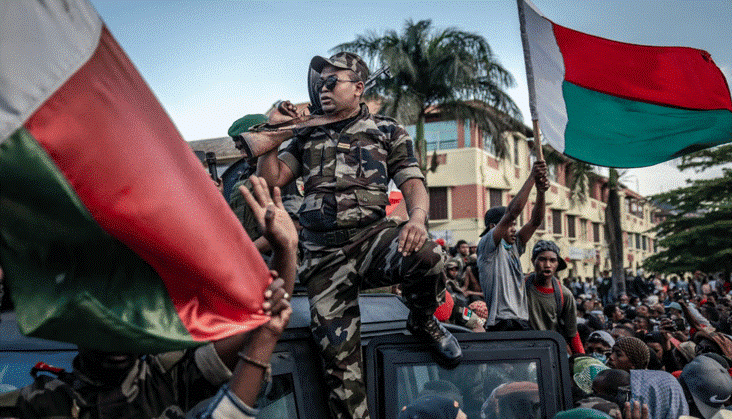
It was just after 5pm on Saturday 11 October when soldiers from the army’s Personnel and Services Administration Corps (CAPSAT) entered Antananarivo. There was gunfire, but the mutineers appeared to meet little resistance, according to our special correspondent. They took up positions on the highly symbolic 13-May Square, in the heart of the capital, and were cheered by a jubilant crowd. Since the 1970s, that is where Malagasy regimes are made and unmade. A jubilant crowd had taken it over during the day.
Several of our sources said for a time that President Andry Rajoelina, boxed in after weeks of protests, had left the city – though this has not yet been confirmed.
A large crowd had gathered a few hours earlier outside CAPSAT’s barracks in Soanierana, near Antananarivo. In a Facebook post that morning, this army contingent called on the security forces to ‘take responsibility’ and to ‘refuse orders to fire’.
‘We’ve become bootlickers’
‘We in the military are no longer doing our job,’ CAPSAT complained. ‘We’ve become bootlickers. We chose to submit and carry out orders even when they were illegal instead of protecting the people. That is what happened in the night of 25 September and during the day on 26 September. And the abuses continue on the ground – beatings and injuries against young students who are only demanding their rights.’ This was an explicit reference to protests launched by the Madagascar Gen Z collective, which began in late September and were met with a violent crackdown by the security forces (22 dead, according to the UN).
Some soldiers quickly answered CAPSAT’s call. The defence ministry, for its part, immediately urged unity in the face of the mutineers. By midday, several sources were reporting a possible attack on the CAPSAT camp by a gendarmerie regiment that remained loyal to President Rajoelina. ‘We know about it, we’re ready, we’re waiting for them,’ a swaggering soldier told Jeune Afrique near the camp.
At the outset, protesters were demanding better access to water and electricity, and denouncing the state of the health system and the level of corruption in Madagascar. Faced with the crackdown – and convinced they were not being heard – they began to call for the resignation of Andry Rajoelina, 51, himself brought to power by the street in 2009, then elected in 2019 and re-elected in 2023.
While denouncing what he called an attempted ‘coup d’état’ against him, the head of state said in recent days that he understood the frustrations of Malagasy youth. He dismissed his entire government, replacing prime minister Christian Ntsay with General Ruphin Fortunat Dimbisoa Zafisambo on 6 October. That did not calm the anger and, on 9 October, thousands of protesters again took to the streets.
On Friday the UN high commissioner for human rights, Volker Türk, called on the authorities to ‘end the use of unnecessary force’, as many more injuries were reported.